I have dropped the domain historiesmysteriesandstrangeness.com and reverted back to the original domain of histmyst.blogspot.com. However, you will also be able to reach the site via historiesmysteriesandstrangeness.guvna.net or just simply hms.guvna.net.
Showing posts with label catholic. Show all posts

Monday, December 23, 2013

A Brief History of Santa Claus

The holiday figure known as Santa Claus nowadays has his origins in the ancient past. The traditions and appearance associated with the modern Santa Claus consists of an amalgam of Christian traditions and pagan Germanic traditions.  Modern traditions and depictions of him are also inspired by Clement Clarke Moore’s popular poem “A Visit from Saint Nicholas” (“‘Twas the night before Christmas”) and songs like “Santa Claus is Coming to Town.” The images below are historical depictions of him and his predecessors.

Saint Nicholas
Saint Nicholas was a 4th century bishop in the town of Myra in what is now modern Turkey. He is known for secretly leaving gold in people’s shoes. In one case, a poor man had three daughters he couldn’t marry off so he was going to sell them into prostitution. Saint Nicholas left a bag of gold for him so he would have a dowry and could marry off his first daughter. Saint Nicholas did the same for his second daughter, but when it was time to marry the third daughter, the man waited up to see who his benefactor was, but Saint Nicholas dropped the gold down the chimney instead. (Image source)

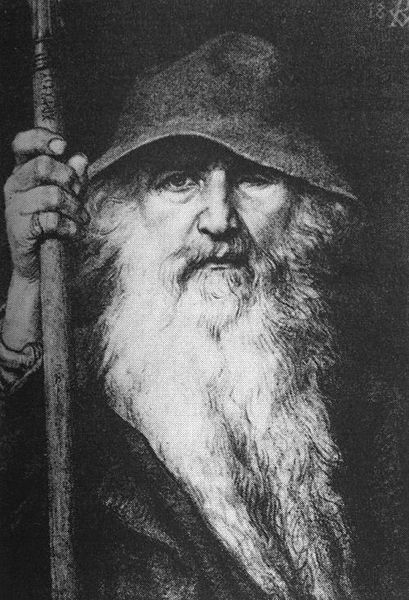
Odin

Odin was a Norse god who was worshiped by Germanic peoples prior to Christian times. After the Germanic peoples converted to Christianity, some of the old Norse traditions from the Yule celebration were absorbed into Christianity.  Odin was known for having a long white beard and riding at night on an 8-legged horse called Sleipnir. (Image source)

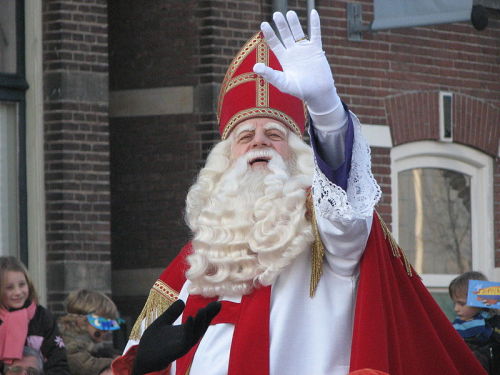
Sinterklaas

Sinterklaas is a Dutch version of Saint Nicholas and dresses in a manner resembling a religious authority such as a Bishop or Cardinal. He is the gift bringer at Christmas in various European countries. (Image Source)

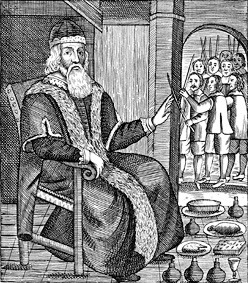
Father Christmas

Father Christmas is an older British version of Santa Claus. (Image source)

Santa Claus as depicted by Thomas Nast in the 1800's.

Thomas Nast is usually credited with designing the modern image of Santa Claus in his various portrayals of him in Harper’s Weekly during the 1800’s. (Image source)


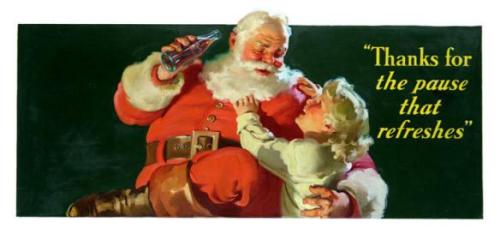
Santa Claus in Coca-Cola ads

Coca-Cola has been credited with popularizing the image of Santa wearing red in their advertisements, but they did not invent the idea of Santa wearing red. Earlier depictions of Santa had him wearing various colors, including red. (Image source)

Sources: 1, 2, 3, 4
(via)


Monday, February 11, 2013

Papal resignation and the Prophecy of the Popes

Well it's been all over the news today that Pope Benedict XVI will be resigning.  According to St. Malachy's Prophecy of the Popes, Benedict would be the second to the last Pope.  Malachy's writings say the next Pope would be known as Peter the Roman.  Interestingly enough, one of the Cardinals that could potentially be elected Pope is actually named Peter.  I guess we will have to stay tuned to the news and see how accurate Malachy's prophecy is.

See a couple of my old posts related to the topic below.

The Prophecy of St. Malachy

Jeane Dixon and the Final Pope

Update: A new Pope has been elected and he took the name of Francis.  His given name is not Peter or a variation thereof either.  So it looks like Malachy's prophecy is a bust (no surprises there though).

Wednesday, December 30, 2009

The Queen of Heaven

Today, the designation 'Queen of Heaven' is often associated with the Virgin Mary.  Historically, the designation has been associated with Isis and Astarte.

In regards to the so-called 'Marian apparitions', it seems to me that the Catholics who claim to have seen the Lady assume she is Mary.  In the accounts that I have read about her, she either refers to herself  as something like 'Lady of the Rosary', or she may not introduce herself at all.  So if she does not specifically introduce herself as the mother of Jesus, why should we assume that she is?

I am not denying that Mary existed; nor am I denying that she gave birth to Jesus.  I'm not denying that she was a virgin either.  The question in my mind is whether or not these so-called Marian apparitions are actually visitations by the spirit of Mary, the mother of Jesus.

What if these apparitions have been appearing for much longer than previously thought?  Could it be that this entity or spirit - whatever you prefer to call her - is the same as Isis?  It's long been thought by mainstream historians that Isis, along with all the other pagan gods and goddesses, is a myth.  Some of the more open minded ones may consider that these ancient pantheons of gods and goddesses were once based on real people that had stories about themselves fabricated or were perhaps fabricated over time.  Fringe historians have suggested that some of the gods and goddesses were aliens or some other type of non-human intelligences.  I tend to think that the gods and goddesses may have once been based on real people, but I can't discount the possibility that the stories are entirely fictional.  But I'm also not closed to the possibility that the pagan gods and goddesses were some sort of aliens, or non-human intelligences - perhaps something akin to angels or fallen angels.  It could be that the pagan pantheons consisted of a combination of any or all three of these viewpoints.

So with that in mind, I can't help but wonder if these apparitions are some sort of non-human intelligent being who has been visiting people for thousands of years.  Maybe she just adapts to the audience.   To the Egyptians, she let them think she was Isis.  To modern Catholics, she lets them think she is Mary.  Mac Tonnies suggested a possibility that the 'aliens' people claim to see today have merely adapted to our cultural expectations.  In the past (and still today, actually), people may have observed such phenomena as gods, angels, fairies, or something else.  Perhaps the aliens are not the scientists with advanced technologies that they are assumed to be; maybe it's just a facade to fit our modern expectations.  The aliens may be something else entirely.  So could it be that this 'Queen of Heaven' (translatable as Queen of the Sky) is doing the same thing?  Does this 'lady' just try to fit the appearance that the viewer(s) would expect?

Catholic traditions that grant Mary her Queen title and divine status come later in history.  The Bible never says that she ascended to heaven and it doesn't say she remained a virgin throughout her lifetime.  In fact, the Bible even makes reference to Mary having other children.  The Catholic version of Mary more closely resembles a pagan goddess than the Mary depicted in the New Testament.   Pagan goddesses of the past were often known by many names and titles, and the alleged apparitions of Mary have many titles too (Lady of the Rosary, Lady of the Pillar, Lady of the Snow, etc).  So the question in my mind remains; are the so-called Marian apparitions actually appearances by Mary?  Or is the apparition actually someone else - perhaps a pagan 'goddess' from the past?  I'm not aware of her ever specifically introducing herself as Mary, but she doesn't deny being Mary either; so does she want people to think she is Mary?  Or does she just not care who they think she is?  Is she content just being called 'Our Lady'?

Of course, skeptics say these apparitions are just hallucinations or hoaxes.  Maybe they are.  But if they are real, I wonder if she is who she is assumed to be.  If she isn't who she is assumed to be, then who - and what - is she?

Thursday, December 3, 2009

Papal Predictions

I've written about predictions of who the final Pope would be before (here and here).  Saint Malachy predicted the last man to rule the Roman Catholic Church would be Peter the Roman.  Jeane Dixon made a prediction that is similar to what Saint Malachy said.  Some previous Pope's have had visions of their own about the subject.

Here is what four previous Popes have said about their visions (Excerpt from the Popes and Prophecy article on Paranormal.About.com.) :

  • Pope Pius IX (1846-78): “There will come a great wonder, which will fill the world with astonishment. This wonder will be preceded by the triumph of revolution. The church will suffer exceedingly. Her servants and her chieftain will be mocked, scourged, and martyred.”
  • Pope Leo XIII (1878-1903): After saying Mass on October 13, 1884, the Pope suddenly collapsed. Upon waking, he recounted a vision he had seen. "Oh, what a horrible picture I was permitted to see!" he said. He described a period of about 100 years when Satan’s power was to reach its maximum, a decline of moral and spiritual values. Those hundred years would have included most of the 20th century.
  • Pope Pius X (1903-14): This Pope had a number of prophetic visions. In 1909, in the midst of an audience with members of the Franciscan order, he seemed to fall into a trance. Moments passed, then his eyes sprung open and he jumped to his feet. "What I have seen is terrifying!” he cried out. “Will I be the one, or will it be a successor? What is certain is that the Pope will leave Rome and, in leaving the Vatican, he will have to pass over the dead bodies of his priests!" It’s uncertain what this vision alluded to, but it is similar in many respects to the reported third prophecy of Fatima. Later, shortly before his death, another vision came to him: "I have seen one of my successors, of the same name, who was fleeing over the bodies of his brethren. He will take refuge in some hiding place; but after a brief respite, he will die a cruel death. Respect for God has disappeared from human hearts. They wish to efface even God's memory. This perversity is nothing less than the beginning of the last days of the world."
  • Pope Pius XII (1939-58) also experienced strange visions of a bleak future. After one of these experiences he told confidants, "Mankind must prepare itself for sufferings such as it has never before experienced… the darkest since the deluge."

These sound similar to what Dixon and Malachy said.  I guess skeptics would probably say they are all just borrowing from Malachy's prophecy.  But what if they are all seeing the same thing?  It should be noted that all of these predictions were made by Catholics.  Are they seeing the end of their own organization?  Is what they have seen going to happen in the not so distant future?  I guess we'll just have to wait and see.

Wednesday, December 2, 2009

The Alien - Angel Topic Revisited


I've written about the alien-angel connection before and dedicated a whole post to the topic a while back.

As I stated previously, the phrase 'angel from heaven' translates to 'messenger from the sky'.  But people have been questioning for a long time whether or not extraterrestrials could exist from a religious perspective.

Here is an article I came across today about it.  But the topic isn't something new, people have been questioning the subject for years.

I guess I'm just really surprised that there is some much confusion about this.  I mean, it just seems like such a non-issue!  If an angel from heaven has come to earth from the sky, then technically, you could classify it as a type of extraterrestrial.  This doesn't mean that the traditional concept of an angel is the only type of extraterrestrial life there is - there may very well be grays, reptillians, insectoids and other types of extraterrestrial life - but the point is, by definition of the phrase 'angel from heaven', angels themselves could very well be considered extraterrestrial.  So the whole question as to whether extraterrestrials exist from a religious perspective is like questioning whether or not angels themselves exist.  I suppose it's possible some angels could actually be terrestrial in origin, but if it's an angel that has specifically come from heaven, then technically, it's an extraterrestrial.  I don't think it matters if it is made of flesh and blood or not, a lifeform is still a lifeform.

So why all the hoopla about whether or not extraterrestrials fit into God's universe?  I guess it's somewhat understandable why some people might question from a religious perspective whether or not specific types of alleged ETs such as grays or reptilians exist, but I see no reason why anyone with a religious perspective should question whether or not extraterrestrials exist at all.

The whole debate just seems like a waste of time to me.  It's like spending years trying to decide whether or not we should say the sky is blue, or say the sky appears to be blue.


H/T for the linked article.

Saturday, November 28, 2009

The Christmas Story

It seems that every year around Christmas, you can find someone pointing out the pagan origins of some of the Christmas rituals and decorations, as well as the pagan connections between the date suggested to be the day of Christ's birth.

Well, this post isn't about all of that.  Instead, I thought I'd clarify a few common misconceptions about the Christmas story as told in the Bible.

Before I get into that though, I want to make a few points about the Gospels themselves.

Each of the four Gospels are written from a different perspective with a specific audience in mind.  Matthew wrote to a Jewish audience, and presented Jesus as the messiah the Jews had been waiting for.  This is why Matthew gives the genealogy of Joseph, Jesus' adoptive father.  Joseph was a direct descendant of King David through Solomon's royal line, giving him legal claim to the throne of David (which, of course, during this period of time, the Romans had control of Palestine).  An adopted child had all the rights of a biological child, thus, Jesus had legal claim to the throne of David through Joseph.  So Matthew gives us the perspective of Jesus being King of the Jews.

Mark's Gospel may have been written to a Roman audience.  Mark portrays Jesus as a servant.

Luke, a gentile, wrote to a Greek audience, and more specifically, to someone named Theophilus (Luke 1:3).  Luke portrayed Jesus as a man, the perfect man.  Greeks were known as thinking men, so this was an appropriate perspective for a Greek audience.  Luke gives us the genealogy of Mary, the mother of Jesus.  Mary was actually a descendant of King David too, although not through Solomon's royal line.  But as the biological mother of Jesus, this was an important genealogy from the perspective of Jesus being human.

The book of John, which was the last of the Gospels written, was probably written to a Christian audience in general.  John emphasized Jesus' divinity.

It's been suggested that the prophet Ezekiel saw a vision that predicted these four records of Jesus.  In chapter one of the book of Ezekiel, Ezekiel mentions seeing a vision of four living creatures.  Here is what he had to say about their faces:
Their faces looked like this: Each of the four had the face of a man, and on the right side each had the face of a lion, and on the left the face of an ox; each also had the face of an eagle.  -Ezekiel 1:10

These four living creatures are also mentioned in the book of Revelation.  The lion symbolizes Kingship.  The Ox (a.k.a. 'beast of burden') was used for pulling carts and ploughs, making it a symbol of servitude.  The face of a man symbolizes..well...a man, and the eagle symbolizes divinity.  In the book of Revelation, the four living creatures are named in the same order that the four Gospels were chosen for inclusion in the Bible.

Huh...I guess maybe the Council of Nicaea did pick the right books to include in the Bible.

Matthew and Luke are the only two Gospel writers that mention the birth of Jesus.  Neither of them said a whole lot about it though.  Neither of them give us a date of his birth, indicating they only thought it was significant that he was born, and not when he was born.  One of the reasons they probably chose to mention his birth was because of the perspective they were writing from.  Matthew needed to convince the Jews that Jesus was the messiah they were waiting for, and Luke wanted people to know that Jesus was a man in flesh and blood.

Luke tells us that an angel informed shepherds that were out with their flocks at night that the messiah had been born.  The shepherds then went to visit Him (Hmm...imagine that, an angel announcing the birth of the messiah to lowly shepherds.  Interesting that the angel didn't bother mentioning it to the 'authorities' and the big government.  I'm still wondering if it is just a coincidence that most alien sightings today are reported by country folk.  And come to think of it, I don't think I've ever heard someone report an alien saying, "Take me to your leader.").

So as for the date of Jesus' birth, it was probably in the spring time.  It wasn't winter, because the shepherds wouldn't have been out with their flocks at night during the winter.  It's possible that it was summertime or fall, but the springtime is probably more likely just because it seems more appropriate.  Spring was (and still is) considered to be a time of new birth, and at one point was considered to be the beginning of the new year (am I the only one that finds it odd we use a calendar that starts the new year in the dead of winter and begins new days in the middle of the night??).  So it seems fitting that the messiah would have been born during a time of new birth.  At this point, I don't see much need in changing the date it's celebrated though.  The Gospel writers didn't bother to include a date, so I guess December 25th is as good as any date.

In a lot of Nativity scenes, you'll see figures of Mary, Joseph, and the baby Jesus along with figures of animals and three wise men.  The problem is, the wise men didn't visit Jesus in a stable as a newborn.  Nor is there any indication there was only three wise men.  The wise men and the shepherds didn't arrive on the same night.  The wise men traveled from the East, and it may have been several days, weeks, or months after the birth when they visited.  By that time, Jesus and his parents were living in a house.  In fact, Matthew 2:10 even states the wise men visited Jesus in a house.  Matthew doesn't say anything about a stable.  We know that the wise men didn't arrive on the night of his birth, because Matthew 2:7 states that Herod asked the wise men when the star they had been following first appeared.  Matthew doesn't explicitly tell us what the wise men told him, but in Matthew 2:16, Herod decreed that all children two years old and younger were to be killed, and he based his decision on the timeframe the wise men had told him.  So going by that, the wise men may have arrived as late as two years after Jesus' birth (Although it probably wasn't quite that long, Herod probably just stated two years and younger in attempt to make sure all his bases were covered.).  It may also be important to note that Matthew says the wise men visited the "child," not the "baby."

The tale of the three wise men, known as Caspar, Melchior, and Balthasar, came several centuries later.  It crept into Christian tradition, and there's even a famous Christmas carol about them.  The Christmas carol further confuses the tale by describing them as being "three kings." But they were not kings.  I'm not aware of any translation of the Bible that describes them as "kings."

I'm not sure why people got the idea that there were only three wise men.  Maybe it's because only three gifts were mentioned.  But naming only three gifts doesn't indicate that only three people came and each gave an individual gift.  I could say that I received money, clothes, and gift cards at Christmas.  But I received those gifts from more than three people.  Additionally, I also received a combination of those gifts from some individuals!  So going by how many different gifts were named is not an indication of how many wise men there were.

More than likely, there were many wise men that came.  They might not have all been traveling together either.  If there were only a few of them, they might not have been granted an audience with King Herod.  The king probably had more to do than meet with a few eccentric astrologers from the East.  But if an entire entourage came, he might have to clear his schedule for that.  Also consider that if there had only been three of them, the king might not have been concerned with them coming into town looking for who they claimed was a newborn king.  Matthew also indicates that the people of Jerusalem were also disturbed by the arrival of the wise men; again, three visiting astrologers probably wouldn't have gotten the whole city into a frenzy.  I don't know how many there were, but I think there were probably more than three.

The story of the manger comes solely from Luke's record.  It's thought that Luke, who was not one of the Twelve, probably consulted the mother Mary as a source for his writings.  Some of the stories he writes about seem as though they may have been told from Mary's perspective, particularly the story of Jesus' birth and the events that led up to it (Luke begins his record by telling the story of the birth of John the Baptist first).  Luke actually skips over the part where Mary and Joseph take Jesus to Egypt to escape King Herod's wrath.  Matthew included it in his record because the prophet Hosea said that God would call his son out of Egypt (Hosea 11:1, Matthew 2:15).  Since Matthew was writing to a Jewish audience, it was necessary to point out the fulfillment of Jewish prophecies.  Luke wasn't writing to a Jewish audience, so he didn't even bother to mention that part of the story.

Neither Matthew or Luke say a whole lot about the birth of Jesus.  They don't dwell on the topic.  Luke mentions an incident at the Temple when Jesus was twelve years old, but both records mainly focus on Jesus as an adult.

What's interesting to me is that some of the Christmas traditions have become so ingrained in the public consciousness, many people don't even notice that some of the traditions aren't a part of the Biblical record.  Even some people that have read the records all the way through don't seem to notice that the Bible never mentions wise men named Caspar, Melchior, and Balthasar visiting Jesus on the night of his birth.

So yes, I suppose it is true that many of the common Christmas traditions are pagan in origin.  A lot of them seem to be adapted from Norse/Scandinavian traditions.  I can't say that I'm surprised though.  The Romans were known for adapting some of the customs of the people they conquered.  It's not mere coincidence that Roman and Greek pantheons were so similar.  The Romans had their own pantheon, but they also adapted aspects of the Greek pantheon into their own.  When Christianity came to Rome, the Romans adapted aspects of it too.  Over the years, Roman Catholics did as their pagan Roman ancestors did.  It took hundreds of years to convert the Scandinavians from their pagan beliefs to Catholic beliefs.  Various methods of forcing them to convert or demonizing their gods were tried.  But they also tried more subtle methods.  Sometimes the Catholics would also blend aspects of the Scandinavian traditions with Catholic beliefs, or in some cases, essentially just tell the Scandinavians the reign of their gods was a thing of the past.  In other words, the Catholics didn't always try to convince the Scandinavians their traditions weren't true, they just tried to convince them they were from an era of the past.  With that in mind, I'm not surprised that ancient Scandinavian traditions have continued into the present day.  Even those cold, snowy Scandinavian winters seem to be the traditional image of what the Christmas season is 'supposed' to look like.

Nevertheless, I love the Christmas season.  I love the cool air, the decorations, the music, and the joy.  So Merry Christmas!

Friday, August 14, 2009

Jeane Dixon and the Final Pope

I came across an article today regarding one of Jeane Dixon's prophecies that allegedly alludes to the rise of the anti-Christ. For those not familiar with Dixon, she was an American psychic and astrologer who is famous for predicting the assassinations of John and Robert Kennedy and is also famous for providing psychic and astrological advice to Presidents Franklin D. Roosevelt and Ronald Reagan (and maybe some others in between them). Although she made many accurate predictions over the years, she also got some wrong too. Her excuse though was the information she received wasn't necessarily wrong, but she had interpreted it wrong. What caught my eye in that article though was a prophecy she had regarding the Papacy. The article quotes her as saying:

"During this century one pope will suffer bodily harm. Another will be assassinated. The assassination will be the final blow to the office of the Holy See. This pope will be the same one who will be chosen in the not too distant future but whose election will not be approved by the Roman clergy. His influence, however, will be such that he will win out over the objections of his opponents. While this pope will be the last one ever to reign as singular head of the Church, the beginnings of this change will occur with one of his predecessors who will give far-reaching powers to his cardinals. These same cardinals will use their powers to replace him with one more to their liking."


That quote reminded me of my recent posting titled The Prophecy of Saint Malachy. It regards Saint Malachy's prediction of who the final person on the throne at the Vatican would be (as well as vague predictions regarding the various popes that would rule during the years leading up to the final Catholic leader). This particular prediction of Jeane Dixon's reminded me of this prophecy. She says that during this century one pope would suffer bodily harm. Considering she published that prediction in the 1970's, that would mean the prediction regards a pope that reigned during the 70's, 80's, or 90's. This would appear to be a reference to Pope John Paul II, who was wounded in an assassination attempt by Mehmet Ali Agca in 1981. Her prediction then says that another pope will be assassinated. What's interesting about that is it says that the assassination will be the final blow to the office of the Holy See (the Pope) and that this particular Pope would be in charge, but that his election would not be approved by the Roman clergy. This sounds very similar to what Saint Malachy said about Peter the Roman. Saint Malachy said that Peter the Roman would be on the throne at the Vatican, but he doesn't explicitly state that Peter the Roman would be elected Pope. So if you compare Saint Malachy's prophecy to Jeane Dixon's, it appears Jeane Dixon may be predicting the assassination of Peter the Roman (Although there is a slight possibility her prediction of a papal assassination is a reference to John Paul I. John Paul I's death after only 33 days in office was said to probably have been a heart attack, but there was no autopsy done, so no one knows for sure. There are conspiracy theories that claim he was actually assassinated. Nevertheless, judging by the context of Jeane Dixon's prediction, I don't think she was making reference to John Paul I, but I thought I would at least point that out.)

So it seems we may have yet another reference to the final pope. I have to wonder though, did Jeane Dixon merely read Saint Malachy's prophecy and adapt it into her own prediction? Or is what she predicted a legitimate prophecy of her own? Judging by her long history of psychic and astrological predictions, it may very well be a legitimate prophecy of hers. We may never really know for sure though. The only thing we can do now is wait and see if her prediction is accurate.

Friday, July 31, 2009

The Prophecy of Saint Malachy

I don't really know why, but for some reason Saint Malachy's prophecy of the last 112 popes popped into my head yesterday. Saint Malachy, a 12th century Irish Saint, wrote 112 short Latin phrases that purport to describe each of the last 112 popes (or their coat of arms). Although they've been around for centuries, they reemerged and gained popularity after the death of Pope John Paul II, because the next Pope (Pope Benedict XVI) would be the second to the last Pope according to the prophecy. The final Pope, PETRUS ROMANUS (Peter the Roman) would come after the death of Pope Benedict XVI, and Peter the Roman would reign during the destruction of the Catholic Church and/or the city of Rome. So anyways, what I thought about doing yesterday was looking for a Cardinal named Peter. I figured if Malachy's prophecy really is accurate (and some claim it is completely accurate, yet the problem I have with them is that they are very vague), then maybe there is a Cardinal named Peter currently living. Well I found a list of cardinals and I think there were five named Peter, but I don't recall any of them being Roman (that is, other than the fact that they are Roman Catholic) or Italian. But apparently I wasn't the first person to get the idea to try and determine who the next Pope may be based on the prophecy of St. Malachy. Others have already looked into the topic and it seems one of the most likely candidates is a priest named Pietro Parolin (Pietro is Italian for Peter). Parolin is currently the Holy See's Undersecretary of State for Relations with States, a high ranking position in the Vatican's diplomatic service. Now some people think that Peter the Roman won't actually be elected as Pope, as the prophecy merely states that he will be on the throne at the time. Malachy gives a lot more detail on Peter the Roman that he does the other popes, leading some to think that he may not actually be a pope, just the guy in charge. When a Pope dies, someone else temporarily handle's the affairs of the state while the Cardinal's are electing a new Pope. So it may be that he isn't an actual Pope, but a regent ruling after the death of the Pope. Or maybe he is elected Pope. That's part of the problem with Malachy's prophecy, it's very vague. Parolin isn't a cardinal, but technically the Pope doesn't have to be a Cardinal; it's just the cardinals typically elect a cardinal.

As for Parolin's background, he does appear to be a fitting candidate. He is not only a high ranking official in the Holy See, but he is also from northern Italy. The area of Italy he is from was part of the Holy Roman Empire during the 12th century when the prophecy was written, so he could be classified as a "Roman" (although we now view the Holy Roman Empire historically as a separate empire from the classical Roman Empire, at the time it was viewed as a continuation of the classical Roman Empire).

So anyways, Peter the Roman is allegedly who will be in charge when Rome is destroyed. Here is the translated prophecy regarding him:

"During the final persecution of the Holy Roman Church, the seat will be occupied by Peter the Roman,
who will feed his sheep in many tribulations;
and when these things are finished, the seven-hilled city will be destroyed,
and the formidable Judge will judge his people.
The End."

What I find most interesting about all this is the timing. This is yet another example of a prophecy that seems to indicate an end of something sometime around the year 2012. Whether this prophecy just indicates the end of Catholic Church, Rome, the world, or any combination of those I don't know. I also find it interesting though because the Bible indicates in Revelation 18 that the city of Rome will be destroyed sometime in the future. Is this a reference to the same event mentioned in the Bible? And why does it seem to indicate an end sometime around the year 2012? I'm still on the fence regarding what the year 2012 will bring, whether it be a great awakening, a major disaster (possibly caused by the Sun), the end of the world, or just business as usual. I don't think anyone can really predict the end of the world, so I don't think that is what it is. But that doesn't mean there couldn't be some other type of major event. I'm also reluctant to take the 2012 apocalypse too seriously just because of how many people have been wrong about when the world was going to end in the past. Some say 2012 is just a spiritual Y2K (meaning theres a big buildup to it, but then nothing happens). But this isn't like Y2K. Y2K only became a notorious apocalyptic scenario in the years prior to the year 2000. The 2012 prophecies are unique in that many people from different parts of the world with different religious beliefs have predicted an end of something around the year 2012 for thousands of years of now. So what really is the big deal about 2012? And what will Peter the Roman have to do with it?
-------------------------
Update 02/12/2013

2012 has come and gone, but the news has reported that Pope Benedict XVI will be resigning his position, and people are already speculating about who the new Pope could be.  Interestingly enough, one of the potential candidates is named Peter!

Update 2:

 A new Pope has been elected and he took the name of Francis.  His given name is not Peter or a variation thereof either.  So it looks like Malachy's prophecy is a bust (no surprises there though).