The fifth angel sounded his trumpet, and I saw a star that had fallen from the sky to the earth. The star was given the key to the shaft of the Abyss. When he opened the Abyss, smoke rose from it like the smoke from a gigantic furnace. The sun and sky were darkened by the smoke from the Abyss. -Revelation 9:1-2
I find Biblical prophecy fascinating. I think it is remarkably accurate from a historic perspective. There are different views on how to interpret Biblical prophecies though. I'm not sure what the statistics are on how many people adhere to one or the other viewpoints, but I think the futurist view is probably the most popular and well known. Simply put, the futurists view many Biblical prophecies as events that have not yet happened. This type of view is what the popular Left Behind book series is based on. It's a very faith based view point, and at one point in time, it was the viewpoint I took.
But there are a couple of other interpretations too. Preterists view Biblical prophecies as historical events that already happened a long time ago around the time the books were written. Historicists, on the other hand, view the prophecies as events that have occurred throughout history. As a history buff, I've come to realize the futurist view just doesn't seem accurate anymore.
For instance, many futurists are expecting a new pagan temple to be built on the site of Temple Mount in Jerusalem with a statue of the anti-christ in it. But it's known that Emperor Hadrian already built a pagan temple to Jupiter on the site of Temple Mount back in the 2nd century. It's a prophecy that has already been fulfilled.
So it seems the futurist view may not be all that accurate. History has taught me the other two views have more merit. And although I think the preterists have made some good arguments for their case, it's the historicist view that I find most accurate. The prophecy at the beginning of this post is one of the reasons why.
In the year 536 AD, a dry fog or veil of dust darkened the skies of Europe and Asia minor for around 12 to 18 months. This event brought decreased temperatures, drought, and food shortages. Contemporary reports indicate the effects of the event extended to Africa, Mesopotamia, and China.
It's not certain what caused the persistent fog or dust, but it's speculated it was the result of either a volcanic eruption or cometary impact (or even a near miss by a comet). In the prophecy above, it almost sounds as if both of those events could have happened. The star falling from the sky could have been a comet and the abyss smoking like a furnace could have been a volcanic eruption. Could both of those events have happened around the same time? I'm not sure what the odds are, but I think it's certainly possible. They could have been separate, unrelated events, or it could be that the cometary impact set in motion a chain reaction under the earth that cause a volcano to erupt. I think it's also possible that the impact alone could have achieved the description of the prophecy. The impact could have created an "abyss" and fires could have occurred that caused the smoke. Regardless of the cause though, reports indicate the skies were darkened for at least a year in 536 AD.
I only recently heard about this historic event. But in my mind, this is just another example of why I consider the historicist interpretation of Biblical prophecy to be the most accurate. The event doesn't fit with the preterist view because it happened long after the Bible was written, but it has already happened, so it's not a future event either.

Showing posts with label Christianity. Show all posts
Showing posts with label Christianity. Show all posts
Saturday, January 11, 2014

Monday, December 23, 2013
A Brief History of Santa Claus
The holiday figure known as Santa Claus nowadays has his origins in the ancient past. The traditions and appearance associated with the modern Santa Claus consists of an amalgam of Christian traditions and pagan Germanic traditions. Modern traditions and depictions of him are also inspired by Clement Clarke Moore’s popular poem “A Visit from Saint Nicholas” (“‘Twas the night before Christmas”) and songs like “Santa Claus is Coming to Town.” The images below are historical depictions of him and his predecessors.
Saint Nicholas was a 4th century bishop in the town of Myra in what is now modern Turkey. He is known for secretly leaving gold in people’s shoes. In one case, a poor man had three daughters he couldn’t marry off so he was going to sell them into prostitution. Saint Nicholas left a bag of gold for him so he would have a dowry and could marry off his first daughter. Saint Nicholas did the same for his second daughter, but when it was time to marry the third daughter, the man waited up to see who his benefactor was, but Saint Nicholas dropped the gold down the chimney instead. (Image source)
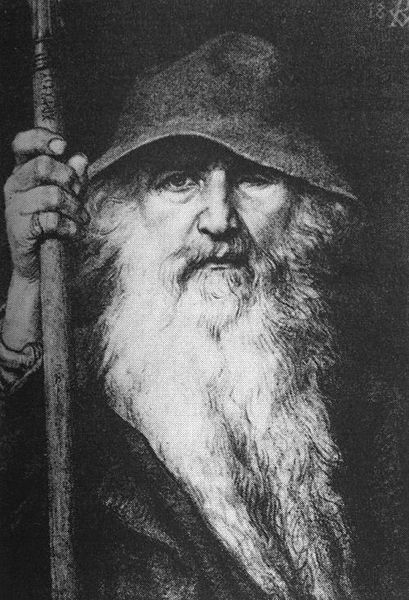
Odin was a Norse god who was worshiped by Germanic peoples prior to Christian times. After the Germanic peoples converted to Christianity, some of the old Norse traditions from the Yule celebration were absorbed into Christianity. Odin was known for having a long white beard and riding at night on an 8-legged horse called Sleipnir. (Image source)
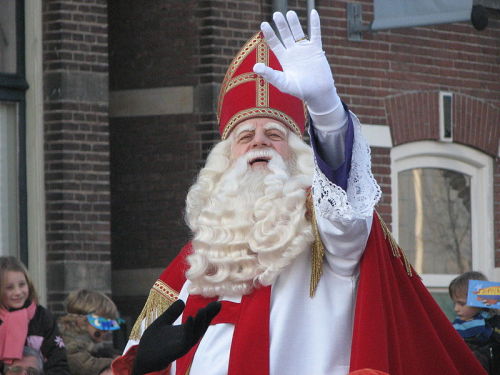
Sinterklaas is a Dutch version of Saint Nicholas and dresses in a manner resembling a religious authority such as a Bishop or Cardinal. He is the gift bringer at Christmas in various European countries. (Image Source)
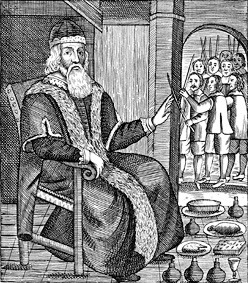
Father Christmas is an older British version of Santa Claus. (Image source)
Thomas Nast is usually credited with designing the modern image of Santa Claus in his various portrayals of him in Harper’s Weekly during the 1800’s. (Image source)
Coca-Cola has been credited with popularizing the image of Santa wearing red in their advertisements, but they did not invent the idea of Santa wearing red. Earlier depictions of Santa had him wearing various colors, including red. (Image source)
Sources: 1, 2, 3, 4
(via)
 |
| Saint Nicholas |

 |
| Odin |
Odin was a Norse god who was worshiped by Germanic peoples prior to Christian times. After the Germanic peoples converted to Christianity, some of the old Norse traditions from the Yule celebration were absorbed into Christianity. Odin was known for having a long white beard and riding at night on an 8-legged horse called Sleipnir. (Image source)
 |
| Sinterklaas |
Sinterklaas is a Dutch version of Saint Nicholas and dresses in a manner resembling a religious authority such as a Bishop or Cardinal. He is the gift bringer at Christmas in various European countries. (Image Source)

 |
| Father Christmas |
Father Christmas is an older British version of Santa Claus. (Image source)
 |
| Santa Claus as depicted by Thomas Nast in the 1800's. |
Thomas Nast is usually credited with designing the modern image of Santa Claus in his various portrayals of him in Harper’s Weekly during the 1800’s. (Image source)
 |
 |
| Santa Claus in Coca-Cola ads |
Coca-Cola has been credited with popularizing the image of Santa wearing red in their advertisements, but they did not invent the idea of Santa wearing red. Earlier depictions of Santa had him wearing various colors, including red. (Image source)
Sources: 1, 2, 3, 4
(via)
Monday, December 24, 2012
Vintage Christmas Pictures
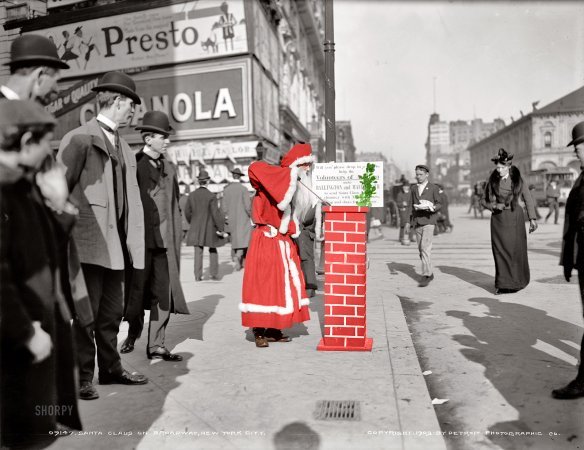
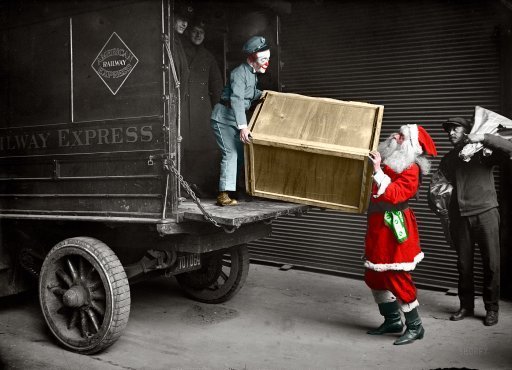
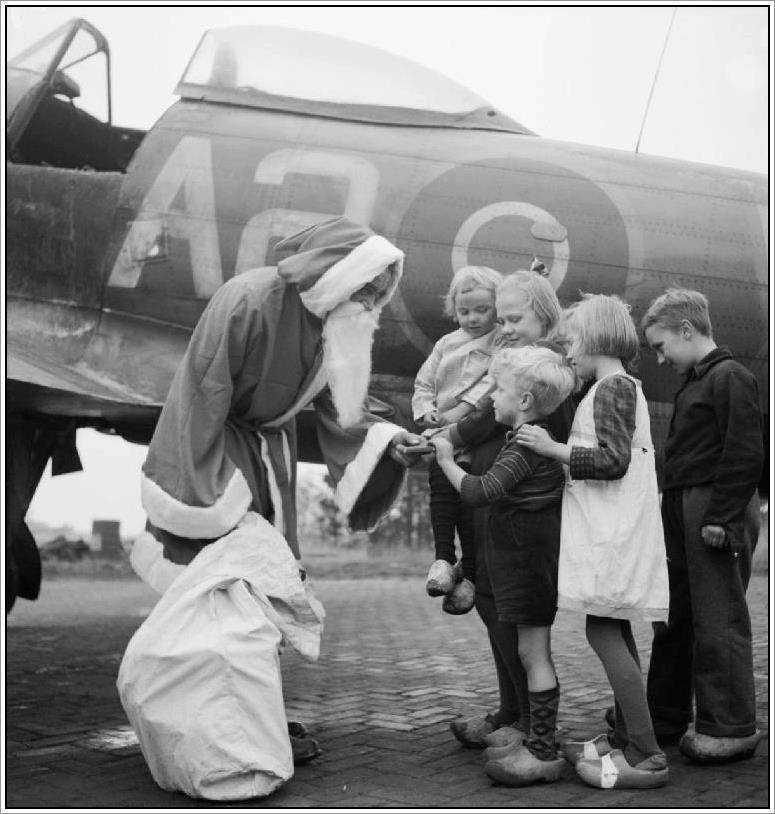
I have a Tumblr blog where I post black and white photos that I colorize or color slash (where only part of the picture is colorized). I did some Christmas ones, so I decided to post the vintage ones here as well. I will post the original picture along with my colorized version.


The first one is a picture from Broadway in 1902, with a color splashed Santa who appears to be taking donations for something, possibly the Salvation Army. Found this picture at a website called Papa Ted’s Place, although I think the image originally comes from Shorpy.
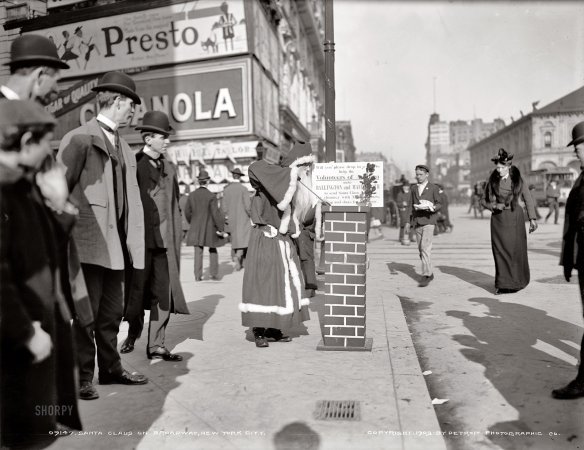
The next one is also from somewhere in New York in 1924. I thought it was a bit odd that Santa was being helped by a clown. I'm not sure if there is any significance to that or not. I did a few color splashes of this one as well as a fully colorized version. The image was found at Shorpy (as well as on Papa Ted’s Place).




This last one was found on the Ghosts of History Facebook page. Here is the description:
“Santa Claus (Leading Aircraftman Fred Fazan from London) hands out presents to Dutch children at Volkel, 13 December 1944. Members of No 122 Wing had saved their sweet ration for weeks, and contributed enough money to give the children their first proper Christmas party. It was noted by the photographer that this year Santa was afraid of Messerschmitts, so he decided to come by RAF Tempest!”

Here's one that should be familiar to a lot of people; a scene from It's a Wonderful Life, one of the most popular and well known classic holiday movies. I color splashed the actors.


You can see more vintage Christmas pictures at Shorpy. Merry Christmas!
Monday, November 26, 2012
The Star of Bethlehem revisited
I wrote about the Star of Bethlehem a few years ago, questioning what it might have been. Many possibilities have been suggested before, but it seemed like none of them matched every aspect of the story.
One of the explanations I mentioned was the astrological conjunction of Jupiter and Regulus. It was definitely one of the better explanations, but at the time, I didn't understand how the star could have stopped over Jesus' house, so I maintained some skepticism. I'm not skeptical anymore though. Since then, I have seen a documentary called The Star of Bethlehem by Frederick A. Larson that explains this theory in great detail. He says that for a 'star' to fit the description, it must meet 9 criteria:
1. It signified birth.
2. It signified kingship.
3. It had a connection with the Jewish nation.
4. It rose in the east, like other stars.
5. It appeared at a precise time.
6. Herod didn't know when it appeared.
7. It endured over time.
8. It was ahead of the Magi as they went south from Jerusalem to Bethlehem.
9. It stopped over Bethlehem.
He explains each of those points with the astrological conjunction of Jupiter and Regulus and makes it easy to understand. He even explains how the star 'stopped' over Bethlehem:
The problem with a planet stopping is not what you might think. The problem is not that planets can’t stop. Just the opposite. The problem is that all planets are always stopped to the eye of a human observer. The sky moves above Earth at half the speed of the hour hand on a common clock. Its movement is imperceptible to the naked eye. So, if all stars are always stopped, what can Matthew have meant?
Perhaps you have already anticipated the key to this final mystery: retrograde motion.I think he has explained it well and I'm convinced this must have been what the Star of Bethlehem was. You can read his detailed breakdown on the website here, although I recommend watching the documentary. I saw it on TV, so you might can find it on there, but it's also for sale on the website in DVD format.
An astronomer tracking the movement of planets through the star field watches not so much on the scale of minutes, but on the longer scale of days, weeks and months.
On this scale of time, Jupiter did stop.
On December 25 of 2 BC as it entered retrograde, Jupiter reached full stop in its travel through the fixed stars. Magi viewing from Jerusalem would have seen it stopped in the sky above the little town of Bethlehem.
Thursday, November 22, 2012
The Christmas Season and The Magic Window
Christmas is my favorite holiday season, but every year, it seems hard to recapture that magic feeling I had as a child. I try to decorate more, listen to more Christmas music, and soak up the seasonal changes and decor around town. But that magic feeling seems so hard to recapture.
Last year I realized it isn't the Christmas season that changes and seemingly makes it hard to grasp that magic feeling, but us. I came across something written by a guy called "Papa Ted" that he called "The Magic Window."
You can see a longer, more descriptive version on this page here (You have to scroll to the bottom of the page to get the Magic Window part, but the other stuff is interesting too if you have time to read it).
What he said about "The Magic Window" really made sense to me. Ultimately, the modern Christmas season hasn't really changed all that much over time, but the Christmases of our childhood that our parents made for us are the Christmases that are really imprinted into our minds. I don't have any children of my own yet, so I can't relive my childhood Christmases through children vicariously like some of my friends already do. But I still hold out hope to recapture that magic feeling of a childhood Christmas every year!
See my past Christmas posts below.
The Christmas Story
The Star of Bethlehem
The Christmas Truce
Music of the Christmas Season
Last year I realized it isn't the Christmas season that changes and seemingly makes it hard to grasp that magic feeling, but us. I came across something written by a guy called "Papa Ted" that he called "The Magic Window."
There is but a very brief window in early childhood for us all, a period of time that lasts from birth until we are cast from the nest and into school. A time when all about the world is new and good. A time when we are open. A time when we take things in so deeply that they will form us ever after. So we imprint upon the Christmas of that time, and what that was is what it will be for us always. That is what collecting is about. The power that an object unseen in decades can have to transport us in mind and spirit back to a specific period or moment of our lives - to unlock long-closed doors in the mansion of our memory - is the true value that it has. We can hold such an object in our hands and know those times were real and welcome back whole parts of who we were into who we are - and let the inner child in each of us out once again to play - to live as part of us and and help us see again through our own "Magic Window." -T.H. Althof
You can see a longer, more descriptive version on this page here (You have to scroll to the bottom of the page to get the Magic Window part, but the other stuff is interesting too if you have time to read it).
What he said about "The Magic Window" really made sense to me. Ultimately, the modern Christmas season hasn't really changed all that much over time, but the Christmases of our childhood that our parents made for us are the Christmases that are really imprinted into our minds. I don't have any children of my own yet, so I can't relive my childhood Christmases through children vicariously like some of my friends already do. But I still hold out hope to recapture that magic feeling of a childhood Christmas every year!
See my past Christmas posts below.
The Christmas Story
The Star of Bethlehem
The Christmas Truce
Music of the Christmas Season
Wednesday, November 21, 2012
Biblical places you might not have known you can physically visit
Jerusalem is the Holy City of three religions and is in the news quite a bit. You often hear Bethlehem mentioned around this time of year because it is the town that Jesus was famously born in. There are many places mentioned in the Bible that can be physically visited today.
There are some places that are mentioned though that you might not have realized you could physically visit. There are places only spirits can go, but sometimes those places were described by alluding to physical places on Earth.
Armageddon
When you hear the word "Armageddon," you probably think of the epic final battle between God and Satan. What you might not know though, is Armageddon is actually a physical place on Earth. Armageddon is the Greek word for the Hebrew "Har Megiddo," meaning "Mount of Megiddo." Megiddo is a valley in Israel and the Mount of Megiddo is the hill overlooking the Valley.
Hell
When you think of Hell, you probably think of a place of eternal fire where damned souls go. What you might not know though, is the description of Hell being a place of fire was actually an allusion to a physical place, Gehenna. Gehenna is the Greek name for the Hebrew "Ge Hinnom," meaning Valley of Hinnom. The Valley of Hinnom is a place where ancient pagans and apostate Israelites once sacrificed children to Molech by fire, which is how the place originally became associated with fire. It became a metaphor for a place where damned souls go because it was considered to be an accursed place due to the pagan child sacrifices that occurred there. In Roman times, it is said the valley was used as a rubbish dump where fires continually burned. The King James Version of the Bible translated this into the Anglo-Saxon word "Hell," meaning a nether world of the dead. "Hell" may be the name of the nether world where damned souls go in the afterlife, but the description of it is a description of a real, physical place on Earth.
Heaven
Heaven may not be a physical place on Earth, but it is a place you can physically go. The word has become associated with a spiritual paradise that is the dwelling place of God. But the word "heaven" originally just meant the sky. The idea was that God and his angels were "out there" somewhere in the sky. And I'm not saying the ancients wrong...I'm not saying that at all. I personally believe there is a spiritual paradise "out there" somewhere. But paradise is paradise, and heaven is sky. So if you've flown in a plane, you can say you've been to "heaven," in a manner of speaking.
It would probably be wise to avoid the battlefield known as Armageddon (or any other battlefield for that matter). We should all live lives that will not damn us to Hell, but grant us admission to Heaven instead. But if you want to visit the physical representations of these places, you can get to them with a plane ticket!
There are some places that are mentioned though that you might not have realized you could physically visit. There are places only spirits can go, but sometimes those places were described by alluding to physical places on Earth.
Armageddon
When you hear the word "Armageddon," you probably think of the epic final battle between God and Satan. What you might not know though, is Armageddon is actually a physical place on Earth. Armageddon is the Greek word for the Hebrew "Har Megiddo," meaning "Mount of Megiddo." Megiddo is a valley in Israel and the Mount of Megiddo is the hill overlooking the Valley.
 |
| Megiddo, Israel - a.k.a. "Armageddon" |
Hell
When you think of Hell, you probably think of a place of eternal fire where damned souls go. What you might not know though, is the description of Hell being a place of fire was actually an allusion to a physical place, Gehenna. Gehenna is the Greek name for the Hebrew "Ge Hinnom," meaning Valley of Hinnom. The Valley of Hinnom is a place where ancient pagans and apostate Israelites once sacrificed children to Molech by fire, which is how the place originally became associated with fire. It became a metaphor for a place where damned souls go because it was considered to be an accursed place due to the pagan child sacrifices that occurred there. In Roman times, it is said the valley was used as a rubbish dump where fires continually burned. The King James Version of the Bible translated this into the Anglo-Saxon word "Hell," meaning a nether world of the dead. "Hell" may be the name of the nether world where damned souls go in the afterlife, but the description of it is a description of a real, physical place on Earth.
 |
| Valley of Hinnom - a.k.a. "Gehenna," which is the place used to describe the spiritual nether world of "Hell" |
Heaven
Heaven may not be a physical place on Earth, but it is a place you can physically go. The word has become associated with a spiritual paradise that is the dwelling place of God. But the word "heaven" originally just meant the sky. The idea was that God and his angels were "out there" somewhere in the sky. And I'm not saying the ancients wrong...I'm not saying that at all. I personally believe there is a spiritual paradise "out there" somewhere. But paradise is paradise, and heaven is sky. So if you've flown in a plane, you can say you've been to "heaven," in a manner of speaking.
 |
| The sky - a.k.a. "Heaven" |
Tuesday, October 18, 2011
New sky and a new planet?
As many times as I have read the book of Revelation in the Bible, I don't know if I have ever really stopped to think much about the first verse of chapter 21. I think I've always just assumed the passage was meant in a spiritual or figurative sense. But yesterday the possibility that it might be suggestive of something physical popped into my mind. Here is what the passage says:
Then I saw “a new heaven and a new earth,” for the first heaven and the first earth had passed away, and there was no longer any sea. -Revelation 21:1
The word 'heaven' means 'sky'. We typically think of Heaven as being the spiritual dwelling place of God -- and I am not suggesting that it isn't -- I'm merely pointing out that when the term 'heaven' is used in that context, the notion is the spiritual dwelling place of God is 'out there' somewhere in the sky. So what exactly is this "new heaven" and "new earth" mentioned in Revelation? It's actually not the only time that is mentioned in the Bible. It is also mentioned in the Old Testament book of Isaiah.
See, I will create
new heavens and a new earth.
The former things will not be remembered,
nor will they come to mind. -Isaiah 65:17
So are these passages suggesting that a new sky and a new earth (new planet) are in humanity's future? In this sense, the sky may more literally refer to the visible constellations and the movement of the stars. But if you were on another planet, the constellations would appear differently. So could that be what is meant by a new sky, or "new heaven?" If so, is this a prediction that humanity will one day move to a different planet, or a "new earth?" The passage in Revelation also says there was no longer any sea, so could that mean that the new planet is quite literally a newly formed planet that a sea hasn't even formed on yet?
I'm not really sure. It's difficult to tell if the passage is meant to be taken figuratively or literally. Is it suggesting that humanity will one day travel to another world on a spaceship? Or is it just saying that humanity will one day travel to a new world in spirit? Going there in spirit would probably be more in line with traditional interpretations. In verse 2 of Revelation 21, John says he saw the Holy City, the new Jerusalem, coming down out of heaven from God. To the ancient alien enthusiast, this probably sounds like a spaceship landing. But I'm not so sure about that. The passage could very well be meant in a spiritual or figurative sense. To me, most of the rest of the chapter seems to be more indicative of something figurative or spiritual. In fact, in verse 10, John even says than an angel carried him away in "Spirit" to see the Holy City coming down out of heaven from God.
John goes on the describe what the city looks like. An ancient alien enthusiast might say he was describing some sort of spacecraft in terms he was familiar with. But it really doesn't sound like that to me. The description really just sounds like the description of a beautiful ancient walled city with enormous wealth.
So what is this passage really saying? Is it humanity's destiny to one day travel through space and settle a new world? Or is just saying that humanity's destiny is to travel to a new world in spirit one day? Judging by the chapter as a whole, I think it probably means in spirit. But hopefully one day it's meaning will become clear to us definitively. We may just have to wait and see what happens. :)
You can read the whole chapter here: Revelation 21
You can read the whole book here: Book of Revelation
Then I saw “a new heaven and a new earth,” for the first heaven and the first earth had passed away, and there was no longer any sea. -Revelation 21:1
The word 'heaven' means 'sky'. We typically think of Heaven as being the spiritual dwelling place of God -- and I am not suggesting that it isn't -- I'm merely pointing out that when the term 'heaven' is used in that context, the notion is the spiritual dwelling place of God is 'out there' somewhere in the sky. So what exactly is this "new heaven" and "new earth" mentioned in Revelation? It's actually not the only time that is mentioned in the Bible. It is also mentioned in the Old Testament book of Isaiah.
See, I will create
new heavens and a new earth.
The former things will not be remembered,
nor will they come to mind. -Isaiah 65:17
So are these passages suggesting that a new sky and a new earth (new planet) are in humanity's future? In this sense, the sky may more literally refer to the visible constellations and the movement of the stars. But if you were on another planet, the constellations would appear differently. So could that be what is meant by a new sky, or "new heaven?" If so, is this a prediction that humanity will one day move to a different planet, or a "new earth?" The passage in Revelation also says there was no longer any sea, so could that mean that the new planet is quite literally a newly formed planet that a sea hasn't even formed on yet?
I'm not really sure. It's difficult to tell if the passage is meant to be taken figuratively or literally. Is it suggesting that humanity will one day travel to another world on a spaceship? Or is it just saying that humanity will one day travel to a new world in spirit? Going there in spirit would probably be more in line with traditional interpretations. In verse 2 of Revelation 21, John says he saw the Holy City, the new Jerusalem, coming down out of heaven from God. To the ancient alien enthusiast, this probably sounds like a spaceship landing. But I'm not so sure about that. The passage could very well be meant in a spiritual or figurative sense. To me, most of the rest of the chapter seems to be more indicative of something figurative or spiritual. In fact, in verse 10, John even says than an angel carried him away in "Spirit" to see the Holy City coming down out of heaven from God.
John goes on the describe what the city looks like. An ancient alien enthusiast might say he was describing some sort of spacecraft in terms he was familiar with. But it really doesn't sound like that to me. The description really just sounds like the description of a beautiful ancient walled city with enormous wealth.
So what is this passage really saying? Is it humanity's destiny to one day travel through space and settle a new world? Or is just saying that humanity's destiny is to travel to a new world in spirit one day? Judging by the chapter as a whole, I think it probably means in spirit. But hopefully one day it's meaning will become clear to us definitively. We may just have to wait and see what happens. :)
You can read the whole chapter here: Revelation 21
You can read the whole book here: Book of Revelation
Monday, December 21, 2009
The Star of Bethlehem

One question that often comes up around this time of year is what the star of Bethlehem was. The star of Bethlehem is the star that heralded the birth of Jesus Christ. Many theories have been suggested as to what it could have been. It's difficult to determine exactly what it was because not much was actually said about it. Here is an excerpt from chapter 2 of the book of Matthew:
Now when Jesus was born in Bethlehem of Judaea in the days of Herod the king, behold, Wise-men from the east came to Jerusalem, saying,
Where is he that is born King of the Jews? for we saw his star in the east, and are come to worship him.
And when Herod the king heard it, he was troubled, and all Jerusalem with him.
And gathering together all the chief priests and scribes of the people, he inquired of them where the Christ should be born.
And they said unto him, In Bethlehem of Judaea: for thus it is written through the prophet,
And thou Bethlehem, land of Judah, Art in no wise least among the princes of Judah: For out of thee shall come forth a governor, Who shall be shepherd of my people Israel.
Then Herod privily called the Wise-men, and learned of them exactly what time the star appeared.
And he sent them to Bethlehem, and said, Go and search out exactly concerning the young child; and when ye have found him, bring me word, that I also may come and worship him.
And they, having heard the king, went their way; and lo, the star, which they saw in the east, went before them, till it came and stood over where the young child was.
And when they saw the star, they rejoiced with exceeding great joy.
Matthew keeps it simple, he just says they saw a star. Apparently a star that can move, and not just along the normal progression of the stars in the night sky. There have been several suggestions as to what the star might have been.
- Comet - A comet would explain the sudden appearance of a star and could even appear to stay in the same place for a while. Although we base our calendar today on the birth of Jesus, most people seem to think Jesus was actually born around 4 BC, as opposed to the year 0. Halley's comet is said to have flown by around 12 BC, but that would be too early. I suppose it's possible another comet could have gone by, possibly a comet that rarely ever passes by earth and has not been recorded before. There is a whole universe out there, so I guess we shouldn't necessarily assume we have recorded every comet that ever has or ever will pass by the earth. However, there is a flaw in the comet theory. A comet may appear suddenly and appear to stay in one spot, but therein lies the problem. The star of Bethlehem didn't stay in one spot. It moved over to the location of Jesus' house.
- Supernova - A supernova is an exploding star that would give off an enormous amount of light. This could account for the sudden appearance of another star. It's possible it may have been too faint to see, but after going supernova, the added brightness may have made it visible. Still, we have the problem with the movement of the star. A supernova wouldn't move outside of the normal progression of stars.
- Astrological conjunction - Considering that the magi from the east were probably astrologers, this sounds like it might be a good explanation. Here is one suggestion of what the astrological sign might have been:
John Mosley, program supervisor for the Griffith Observatory in Los Angeles believes the Christmas star was a rare series of planetary conjunctions that took place in during the years 3 B.C. and 2 B.C. "The show started on the morning of June 12 in 3 B.C., when Venus could be sighted very close to Saturn in the eastern sky," says an MSNBC article about Mosley's findings. "Then there was a spectacular pairing of Venus and Jupiter on Aug. 12 in the constellation Leo, which ancient astrologers associated with the destiny of the Jews. Between September of 3 B.C. and June of 2 B.C., Jupiter passed by the star Regulus in Leo, reversed itself and passed it again, then turned back and passed the star a third time. This was another remarkable event, since astrologers considered Jupiter the kingly planet and regarded Regulus as the 'king star.' The crowning touch came on June 17, when Jupiter seemed to approach so close to Venus that, without binoculars, they would have looked like a single star."It appears to be in the right timeframe and may even explain how the star was able to move in the sky. Even the astrological significance of the event sounds kind of fitting. However, the passage in Matthew says that the star went and stood over the location where Jesus was. It doesn't say the star just moved in the sky and then the wise men went towards the direction of the star until they bumped into Jesus' house. Perhaps that is what it meant, but that isn't what it actually says. It said it stood over the house.
- (Update 11/26/12: I've come to prefer this explanation since I originally wrote this piece. See my new posting about this here.)
- UFO - In the strictest definition of the acronym, I suppose you could say the star was an unidentified flying object. That's not to say it was necessarily a metal spaceship built by aliens, it's just saying that it was an unidentified flying object. But, some kind spaceship would explain how it was able to change positions in the sky.
These are the most common explanations. We now know that stars are actually big balls of burning plasma, and they maintain a normal progression in the sky. So we know that a star itself didn't just move out of its normal progression because stars can't do that.....
......or can they? It wouldn't be the last time a star moved - or at least appeared to move - out of its normal progression. In Fatima, Portugal in 1917, thousands of people saw the sun spin around and 'dance' in sky. The dancing sun was accompanied by an apparition who called herself the Lady of the Rosary (presumed to be Mary, the mother of Jesus, by Catholics). Of course, billions of other people didn't notice the sun doing this, so apparently the so called 'miracle of the sun' was only visible to those people assembled in the Cova da Iria fields in Fatima (and apparently not everyone in attendance there saw the sun do anything out of the ordinary). But the fact that only a limited number of people observed the sun dance may be significant. If you read chapter 2 of the book of Matthew, it seems that Herod and the Judeans hadn't noticed the star had appeared. Not only that, considering the passage says the wise men followed the star to Jesus' house, it may be that the wise men were the only ones that saw the star move. I don't know what the Lady of the Rosary did to make the sun appear to move in the sky in front of thousands of people, but if she could do it, I suppose a similar event could have occurred a couple thousand years ago with another star.
Even if what the Lady of the Rosary did and what happened in Bethlehem in 2000 years ago are totally unrelated phenomena, I don't think we should assume that it wasn't some other kind of supernatural event. I mean, it's not like it's the only supernatural event recorded in the Bible. Unless you are someone who is 100% skeptical of anything supernatural, there's no reason to assume that the appearance and movement of the star of Bethlehem couldn't have been a supernatural event.
However, there is another question about the star of Bethlehem that I think often gets overlooked. People are so busy trying to figure out what it could have been, they don't bother to ask why the wise men associated the appearance of the star with the birth of Christ. I've asked that question before, and no one seems to have a good answer. Sometimes people don't seem to even understand the question when I ask. They'll answer by trying to explain what the star was. But that's not what I was asking. What I'm asking is how did the wise men know exactly what the significance of the star was? How did they know to travel west to Bethlehem to visit Jesus? How did they know the star appeared because of the birth of Christ?
The only answer I've ever really gotten is the suggestion that maybe the Jews, who were held captive in Babylon and Persia for 70 years, passed along a story of a star appearing that would herald the birth of the Christ. It sounds plausible that eastern astrologers might have learned about Jewish traditions while the Jews were held captive, however, there is no record of a Jewish tradition concerning a star appearing at the birth of the Christ. Some people have suggested that Numbers 24:17 is a prophecy of the star of Bethlehem, but I disagree. I think the passage has been taken out of context, and furthermore, the passage doesn't specify anything about what the star would look like or where it would appear in the sky. So if Jews living during the Babylonian captivity passed along a tradition about a star appearing to herald the birth of the Christ, then that tradition has been lost to history.
So I'm still left wondering how the wise men knew what to associate the appearance of the star with. If we knew the answer to that, we might be able to figure what the star was (or which one appeared to move). I guess it's just one of history's mysteries though.
----------
Update 11/26/12: I now prefer the astrological conjuction theory and have written a new posting about it. Click the link below to read it.
The Star of Bethlehem revisited
......or can they? It wouldn't be the last time a star moved - or at least appeared to move - out of its normal progression. In Fatima, Portugal in 1917, thousands of people saw the sun spin around and 'dance' in sky. The dancing sun was accompanied by an apparition who called herself the Lady of the Rosary (presumed to be Mary, the mother of Jesus, by Catholics). Of course, billions of other people didn't notice the sun doing this, so apparently the so called 'miracle of the sun' was only visible to those people assembled in the Cova da Iria fields in Fatima (and apparently not everyone in attendance there saw the sun do anything out of the ordinary). But the fact that only a limited number of people observed the sun dance may be significant. If you read chapter 2 of the book of Matthew, it seems that Herod and the Judeans hadn't noticed the star had appeared. Not only that, considering the passage says the wise men followed the star to Jesus' house, it may be that the wise men were the only ones that saw the star move. I don't know what the Lady of the Rosary did to make the sun appear to move in the sky in front of thousands of people, but if she could do it, I suppose a similar event could have occurred a couple thousand years ago with another star.
Even if what the Lady of the Rosary did and what happened in Bethlehem in 2000 years ago are totally unrelated phenomena, I don't think we should assume that it wasn't some other kind of supernatural event. I mean, it's not like it's the only supernatural event recorded in the Bible. Unless you are someone who is 100% skeptical of anything supernatural, there's no reason to assume that the appearance and movement of the star of Bethlehem couldn't have been a supernatural event.
However, there is another question about the star of Bethlehem that I think often gets overlooked. People are so busy trying to figure out what it could have been, they don't bother to ask why the wise men associated the appearance of the star with the birth of Christ. I've asked that question before, and no one seems to have a good answer. Sometimes people don't seem to even understand the question when I ask. They'll answer by trying to explain what the star was. But that's not what I was asking. What I'm asking is how did the wise men know exactly what the significance of the star was? How did they know to travel west to Bethlehem to visit Jesus? How did they know the star appeared because of the birth of Christ?
The only answer I've ever really gotten is the suggestion that maybe the Jews, who were held captive in Babylon and Persia for 70 years, passed along a story of a star appearing that would herald the birth of the Christ. It sounds plausible that eastern astrologers might have learned about Jewish traditions while the Jews were held captive, however, there is no record of a Jewish tradition concerning a star appearing at the birth of the Christ. Some people have suggested that Numbers 24:17 is a prophecy of the star of Bethlehem, but I disagree. I think the passage has been taken out of context, and furthermore, the passage doesn't specify anything about what the star would look like or where it would appear in the sky. So if Jews living during the Babylonian captivity passed along a tradition about a star appearing to herald the birth of the Christ, then that tradition has been lost to history.
So I'm still left wondering how the wise men knew what to associate the appearance of the star with. If we knew the answer to that, we might be able to figure what the star was (or which one appeared to move). I guess it's just one of history's mysteries though.
----------
Update 11/26/12: I now prefer the astrological conjuction theory and have written a new posting about it. Click the link below to read it.
Wednesday, December 2, 2009
The Alien - Angel Topic Revisited

I've written about the alien-angel connection before and dedicated a whole post to the topic a while back.
As I stated previously, the phrase 'angel from heaven' translates to 'messenger from the sky'. But people have been questioning for a long time whether or not extraterrestrials could exist from a religious perspective.
Here is an article I came across today about it. But the topic isn't something new, people have been questioning the subject for years.
I guess I'm just really surprised that there is some much confusion about this. I mean, it just seems like such a non-issue! If an angel from heaven has come to earth from the sky, then technically, you could classify it as a type of extraterrestrial. This doesn't mean that the traditional concept of an angel is the only type of extraterrestrial life there is - there may very well be grays, reptillians, insectoids and other types of extraterrestrial life - but the point is, by definition of the phrase 'angel from heaven', angels themselves could very well be considered extraterrestrial. So the whole question as to whether extraterrestrials exist from a religious perspective is like questioning whether or not angels themselves exist. I suppose it's possible some angels could actually be terrestrial in origin, but if it's an angel that has specifically come from heaven, then technically, it's an extraterrestrial. I don't think it matters if it is made of flesh and blood or not, a lifeform is still a lifeform.
So why all the hoopla about whether or not extraterrestrials fit into God's universe? I guess it's somewhat understandable why some people might question from a religious perspective whether or not specific types of alleged ETs such as grays or reptilians exist, but I see no reason why anyone with a religious perspective should question whether or not extraterrestrials exist at all.
The whole debate just seems like a waste of time to me. It's like spending years trying to decide whether or not we should say the sky is blue, or say the sky appears to be blue.
H/T for the linked article.
Monday, November 30, 2009
The Christmas Truce

One of my favorite Christmas stories is the story of the 'Christmas Truce' in Ypres, Belgium during World War I. Here's part of the Wikipedia entry on the subject:
The truce began on Christmas Eve, 24 December 1914, when German troops began decorating the area around their trenches in the region of Ypres, Belgium, for Christmas. They began by placing candles on trees, then continued the celebration by singing Christmas carols, most notably Stille Nacht (Silent Night). The British troops in the trenches across from them responded by singing English carols.
The two sides continued by shouting Christmas greetings to each other. Soon thereafter, there were calls for visits across the "No Man's Land" where small gifts were exchanged — whisky, jam, cigars, chocolate, and the like. The soldiers exchanged gifts, sometimes addresses, and drank together. The artillery in the region fell silent that night. The truce also allowed a breathing spell where recently-fallen soldiers could be brought back behind their lines by burial parties. Proper burials took place as soldiers from both sides mourned the dead together and paid their respects.
The truce spread to other areas of the lines, and there are many stories of football matches between the opposing forces.
In many sectors, the truce lasted through Christmas night, but in some areas, it continued until New Year's Day.If you don't trust Wikipedia, you can check the Snopes entry for confirmation that it's a true story. The Wikipedia entry also lists some other truces that occurred around the same time.
I'm reminded of an old Herbert Hoover quote, "Older men declare war. But it is the youth who must fight and die." A leader's power base rests solely on his or her followers devotion. If you really think about it, wars are actually battles between leaders, yet the followers are the ones who do the dirty work. Oftentimes, the followers are convinced they are fighting for a noble cause, other times they fight because their leader has promised them new land and wealth, and, of course, some fight to protect what they already have. I'm not saying that the followers of one maniacal leader are any less of a threat because they are followers, I'm just saying that without a leader to guide them, the followers probably wouldn't even know who the enemy is...if there was an enemy at all!
I think the Christmas truce displays a good example of what I mean. Many of the British and German troops fighting each other in Belgium in 1914 were probably scared teens just out of school and young fathers who'd have rather been at home with their wives and kids. I imagine for many of them, fighting a bloody war was one of the last things they'd have want to been doing on Christmas eve...or any other time for that matter. I guess you could say the Spirit of the season came over them, and the two opposing sides ceased fire and celebrated together. I think these men realized that they weren't really enemies. The King and the Kaiser may have been enemies, but the soldiers on the field realized they didn't really have a beef with each other. The Germans were doing what the Kaiser wanted them to do, and the British were doing what the British government wanted them to do.
Once the commanders found out that their soldiers weren't fighting anymore, they ordered them to begin fighting again. But if you think about it, if all the soldiers continued to refuse to fight, the war would have been over. If they had refused to fight in the first place, then World War I would have pretty much been limited to a bar fight among cousins from a dysfunctional family (Kaiser Wilhem, King George, and Tsar Nicholas were cousins). Looking back, I think the German and British soldiers would have been better off arresting their leaders and putting them in prison. They would have probably prevented the continued bloodshed and heartaches the people of the time were faced with.
But I suppose most people are just inclined to be followers. And it seems that throughout history, even when there is a coup, there is always someone else there to step in and lead the followers. History thus far suggests that an unfortunate consequence of that is war.
I'm also reminded of what George Orwell said about his inspiration to write his novel Animal Farm:
"I saw a little boy, perhaps ten years old, driving a huge carthorse along a narrow path, whipping it whenever it tried to turn. It struck me that if only such animals became aware of their strength we should have no power over them, and that men exploit animals in much the same way as the rich exploit the proletariat."
Ah...if only all the followers realized they didn't need to fight their leader's battles. Then their leaders would be nothing but eccentric loners.
I think that Colonel Parker from M*A*S*H may have been on to something when he said, "Sometimes I think it should be a rule of war that you have to see somebody up close and get to know him before you can shoot him." I imagine that might help prevent some needless deaths.
Nevertheless, my rantings on followers fighting the battles of the leaders aside, the Christmas truce is an awesome story and displays the Spirit of the season magnificently well. If only all people would continue in that spirit year round!
Sunday, November 29, 2009
Music of the Christmas Season

One of my favorite parts of the Christmas season is the music. The cold air and decorations do their part, but the music is what really puts me in the mood. In fact, the music itself can conjure up thoughts of winter weather and halls decked with boughs of holly even if you're in area where you don't see a lot of winter weather.
My favorite Christmas songs consist mostly of the religious themed ones. I'm not much into the whole Santa Claus and reindeer thing, although I do like some of the secular songs.
Here are some of my favorites. They are in no particular order, but I am saving my favorite for last.
Christmas Eve Sarajevo (Medley of God Rest Ye Merry Gentleman and Carol of the Bells)
Artist: Trans-Siberian Orchestra
Ok, so this is actually a medley of the older Christmas carols God Rest Ye Merry Gentleman and Carol of the Bells (both of which are favorites of mine), but the Trans-Siberian Orchestra named their medley of them and there is a story behind the name. Here is part of the Wikipedia entry on it:
We heard about this cello player born in Sarajevo many years ago (Vedran Smailović) who left when he was fairly young to go on to become a well-respected musician, playing with various symphonies throughout Europe. Many decades later, he returned to Sarajevo as an elderly man—at the height of the Bosnian War, only to find his city in complete ruins.
I think what most broke this man's heart was that the destruction was not done by some outside invader or natural disaster—it was done by his own people. At that time, Serbs were shelling Sarajevo every night. Rather than head for the bomb shelters like his family and neighbors, this man went to the town square, climbed onto a pile of rubble that had once been the fountain, took out his cello, and played Mozart and Beethoven as the city was bombed.
He came every night and began playing Christmas carols from that same spot. It was just such a powerful image—a white-haired man silhouetted against the cannon fire, playing timeless melodies to both sides of the conflict amid the rubble and devastation of the city he loves. Some time later, a reporter traced him down to ask why he did this insanely stupid thing. The old man said that it was his way of proving that despite all evidence to the contrary, the spirit of humanity was still alive in that place.
The song basically wrapped itself around him. We used some of the oldest Christmas melodies we could find, like "God Rest Ye Merry Gentlemen" and "Carol of the Bells" (which is from Ukraine, near that region). The orchestra represents one side, the rock band the other, and single cello represents that single individual, that spark of hope.Here is the music video:
Christmas Canon
Artist: Trans-Siberian Orchestra
This is actually Pachelbel's Canon with Christmas lyrics. The orchestra not only does a great job, but the lyrics and children's choir complement it well.
O Come, O Come Emmanuel
Artist: Various
This one has a very old sound to it, and it probably dates back to the middle ages. It's translated from a Catholic Latin text called "Veni, veni, Emmanuel." The lyrics are based on text from the from seventh chapter of the book of Isaiah. It kind of reminds me of an old Gregorian chant type of sound. Not only do I like the lyrical message, I like the historical sound of the song. Here's Enya's version of it:
O Come All Ye Faithful
Artist: Various
This song is another one that is centuries old, and is attributed to John Francis Wade. It was originally titled "Adeste Fideles" in Latin and was translated into English by Frederick Oakeley.
Joy to the World
Artist: Various (Written by Isaac Watts)
Technically, this isn't even a song about the birth of Christ. The song is about the second coming of Christ, but for some reason, people started singing it as a Christmas song. Nonetheless, it is an awesome song and I think is best sung by a large choir.
Silent Night, Holy Night
Artist: Various (Written by Josef Mohr and Franz Xaver Gruber)
This is another good one that has been sung by many people.
Most people classify Christmas songs as religious or secular. Well, I complicate things a little more by adding a third category that includes songs that aren't overly religious or overly secular. I just think of them as songs about people celebrating Christmas, as opposed to songs specifically about the Christmas story or about Santa Claus and shopping.
A Holly Jolly Christmas
Artist: Burl Ives, Quinto Sisters
It would be hard to imagine December coming and going without hearing Burl Ives crooning his famous rendition of "A Holly Jolly Christmas". I classify this as a song about people celebrating Christmas. Ironically, this song was written by a Jewish songwriter named Johnny Marks.
All I Want for Christmas is You
Artist: Vince Vance and the Valiants
I classify this song as secular. Although I'm not a particularly big fan of a lot of the secular Christmas songs, this one is an exception. I just love the singer's voice and the song's beat. I remember playing this song at a place I worked a few years back, and a Jehovah's Witness (who don't celebrate Christmas) even admitted to liking it and started dancing to it! It's very upbeat and helps get you in the mood.
As I said earlier, I would save my favorite for last. So here it is.
O Holy Night
Artist: Various
My favorite Christmas song is O Holy Night. I've heard many beautiful versions of this song and it's hard to narrow it to a specific artist's version, but if I had to pick one, I think I would go with Jim Nabor's version of the song. Yes, the same Jim Nabors that played Gomer Pyle. Don't let the goofy Gomer act fool you, Nabors actually has an awesome operatic singing voice. In fact, I'd say he has one of the best singing voices that I've heard.
This was certainly not an exhaustive list of my favorites. I have many other favorites, including It's Beginning to Look a Like a Lot Christmas, Silver Bells, Sleigh Ride, Hark! The Herald Angels Sing, The Little Drummer Boy and many more.
I think Christmas music is what gets me more in the mood for the season than anything else!
Saturday, November 28, 2009
The Christmas Story
It seems that every year around Christmas, you can find someone pointing out the pagan origins of some of the Christmas rituals and decorations, as well as the pagan connections between the date suggested to be the day of Christ's birth.
Well, this post isn't about all of that. Instead, I thought I'd clarify a few common misconceptions about the Christmas story as told in the Bible.
Before I get into that though, I want to make a few points about the Gospels themselves.
Each of the four Gospels are written from a different perspective with a specific audience in mind. Matthew wrote to a Jewish audience, and presented Jesus as the messiah the Jews had been waiting for. This is why Matthew gives the genealogy of Joseph, Jesus' adoptive father. Joseph was a direct descendant of King David through Solomon's royal line, giving him legal claim to the throne of David (which, of course, during this period of time, the Romans had control of Palestine). An adopted child had all the rights of a biological child, thus, Jesus had legal claim to the throne of David through Joseph. So Matthew gives us the perspective of Jesus being King of the Jews.
Mark's Gospel may have been written to a Roman audience. Mark portrays Jesus as a servant.
Luke, a gentile, wrote to a Greek audience, and more specifically, to someone named Theophilus (Luke 1:3). Luke portrayed Jesus as a man, the perfect man. Greeks were known as thinking men, so this was an appropriate perspective for a Greek audience. Luke gives us the genealogy of Mary, the mother of Jesus. Mary was actually a descendant of King David too, although not through Solomon's royal line. But as the biological mother of Jesus, this was an important genealogy from the perspective of Jesus being human.
The book of John, which was the last of the Gospels written, was probably written to a Christian audience in general. John emphasized Jesus' divinity.
It's been suggested that the prophet Ezekiel saw a vision that predicted these four records of Jesus. In chapter one of the book of Ezekiel, Ezekiel mentions seeing a vision of four living creatures. Here is what he had to say about their faces:
These four living creatures are also mentioned in the book of Revelation. The lion symbolizes Kingship. The Ox (a.k.a. 'beast of burden') was used for pulling carts and ploughs, making it a symbol of servitude. The face of a man symbolizes..well...a man, and the eagle symbolizes divinity. In the book of Revelation, the four living creatures are named in the same order that the four Gospels were chosen for inclusion in the Bible.
Huh...I guess maybe the Council of Nicaea did pick the right books to include in the Bible.
Matthew and Luke are the only two Gospel writers that mention the birth of Jesus. Neither of them said a whole lot about it though. Neither of them give us a date of his birth, indicating they only thought it was significant that he was born, and not when he was born. One of the reasons they probably chose to mention his birth was because of the perspective they were writing from. Matthew needed to convince the Jews that Jesus was the messiah they were waiting for, and Luke wanted people to know that Jesus was a man in flesh and blood.
Luke tells us that an angel informed shepherds that were out with their flocks at night that the messiah had been born. The shepherds then went to visit Him (Hmm...imagine that, an angel announcing the birth of the messiah to lowly shepherds. Interesting that the angel didn't bother mentioning it to the 'authorities' and the big government. I'm still wondering if it is just a coincidence that most alien sightings today are reported by country folk. And come to think of it, I don't think I've ever heard someone report an alien saying, "Take me to your leader.").
So as for the date of Jesus' birth, it was probably in the spring time. It wasn't winter, because the shepherds wouldn't have been out with their flocks at night during the winter. It's possible that it was summertime or fall, but the springtime is probably more likely just because it seems more appropriate. Spring was (and still is) considered to be a time of new birth, and at one point was considered to be the beginning of the new year (am I the only one that finds it odd we use a calendar that starts the new year in the dead of winter and begins new days in the middle of the night??). So it seems fitting that the messiah would have been born during a time of new birth. At this point, I don't see much need in changing the date it's celebrated though. The Gospel writers didn't bother to include a date, so I guess December 25th is as good as any date.
In a lot of Nativity scenes, you'll see figures of Mary, Joseph, and the baby Jesus along with figures of animals and three wise men. The problem is, the wise men didn't visit Jesus in a stable as a newborn. Nor is there any indication there was only three wise men. The wise men and the shepherds didn't arrive on the same night. The wise men traveled from the East, and it may have been several days, weeks, or months after the birth when they visited. By that time, Jesus and his parents were living in a house. In fact, Matthew 2:10 even states the wise men visited Jesus in a house. Matthew doesn't say anything about a stable. We know that the wise men didn't arrive on the night of his birth, because Matthew 2:7 states that Herod asked the wise men when the star they had been following first appeared. Matthew doesn't explicitly tell us what the wise men told him, but in Matthew 2:16, Herod decreed that all children two years old and younger were to be killed, and he based his decision on the timeframe the wise men had told him. So going by that, the wise men may have arrived as late as two years after Jesus' birth (Although it probably wasn't quite that long, Herod probably just stated two years and younger in attempt to make sure all his bases were covered.). It may also be important to note that Matthew says the wise men visited the "child," not the "baby."
The tale of the three wise men, known as Caspar, Melchior, and Balthasar, came several centuries later. It crept into Christian tradition, and there's even a famous Christmas carol about them. The Christmas carol further confuses the tale by describing them as being "three kings." But they were not kings. I'm not aware of any translation of the Bible that describes them as "kings."
I'm not sure why people got the idea that there were only three wise men. Maybe it's because only three gifts were mentioned. But naming only three gifts doesn't indicate that only three people came and each gave an individual gift. I could say that I received money, clothes, and gift cards at Christmas. But I received those gifts from more than three people. Additionally, I also received a combination of those gifts from some individuals! So going by how many different gifts were named is not an indication of how many wise men there were.
More than likely, there were many wise men that came. They might not have all been traveling together either. If there were only a few of them, they might not have been granted an audience with King Herod. The king probably had more to do than meet with a few eccentric astrologers from the East. But if an entire entourage came, he might have to clear his schedule for that. Also consider that if there had only been three of them, the king might not have been concerned with them coming into town looking for who they claimed was a newborn king. Matthew also indicates that the people of Jerusalem were also disturbed by the arrival of the wise men; again, three visiting astrologers probably wouldn't have gotten the whole city into a frenzy. I don't know how many there were, but I think there were probably more than three.
The story of the manger comes solely from Luke's record. It's thought that Luke, who was not one of the Twelve, probably consulted the mother Mary as a source for his writings. Some of the stories he writes about seem as though they may have been told from Mary's perspective, particularly the story of Jesus' birth and the events that led up to it (Luke begins his record by telling the story of the birth of John the Baptist first). Luke actually skips over the part where Mary and Joseph take Jesus to Egypt to escape King Herod's wrath. Matthew included it in his record because the prophet Hosea said that God would call his son out of Egypt (Hosea 11:1, Matthew 2:15). Since Matthew was writing to a Jewish audience, it was necessary to point out the fulfillment of Jewish prophecies. Luke wasn't writing to a Jewish audience, so he didn't even bother to mention that part of the story.
Neither Matthew or Luke say a whole lot about the birth of Jesus. They don't dwell on the topic. Luke mentions an incident at the Temple when Jesus was twelve years old, but both records mainly focus on Jesus as an adult.
What's interesting to me is that some of the Christmas traditions have become so ingrained in the public consciousness, many people don't even notice that some of the traditions aren't a part of the Biblical record. Even some people that have read the records all the way through don't seem to notice that the Bible never mentions wise men named Caspar, Melchior, and Balthasar visiting Jesus on the night of his birth.
So yes, I suppose it is true that many of the common Christmas traditions are pagan in origin. A lot of them seem to be adapted from Norse/Scandinavian traditions. I can't say that I'm surprised though. The Romans were known for adapting some of the customs of the people they conquered. It's not mere coincidence that Roman and Greek pantheons were so similar. The Romans had their own pantheon, but they also adapted aspects of the Greek pantheon into their own. When Christianity came to Rome, the Romans adapted aspects of it too. Over the years, Roman Catholics did as their pagan Roman ancestors did. It took hundreds of years to convert the Scandinavians from their pagan beliefs to Catholic beliefs. Various methods of forcing them to convert or demonizing their gods were tried. But they also tried more subtle methods. Sometimes the Catholics would also blend aspects of the Scandinavian traditions with Catholic beliefs, or in some cases, essentially just tell the Scandinavians the reign of their gods was a thing of the past. In other words, the Catholics didn't always try to convince the Scandinavians their traditions weren't true, they just tried to convince them they were from an era of the past. With that in mind, I'm not surprised that ancient Scandinavian traditions have continued into the present day. Even those cold, snowy Scandinavian winters seem to be the traditional image of what the Christmas season is 'supposed' to look like.
Nevertheless, I love the Christmas season. I love the cool air, the decorations, the music, and the joy. So Merry Christmas!
Well, this post isn't about all of that. Instead, I thought I'd clarify a few common misconceptions about the Christmas story as told in the Bible.
Before I get into that though, I want to make a few points about the Gospels themselves.
Each of the four Gospels are written from a different perspective with a specific audience in mind. Matthew wrote to a Jewish audience, and presented Jesus as the messiah the Jews had been waiting for. This is why Matthew gives the genealogy of Joseph, Jesus' adoptive father. Joseph was a direct descendant of King David through Solomon's royal line, giving him legal claim to the throne of David (which, of course, during this period of time, the Romans had control of Palestine). An adopted child had all the rights of a biological child, thus, Jesus had legal claim to the throne of David through Joseph. So Matthew gives us the perspective of Jesus being King of the Jews.
Mark's Gospel may have been written to a Roman audience. Mark portrays Jesus as a servant.
Luke, a gentile, wrote to a Greek audience, and more specifically, to someone named Theophilus (Luke 1:3). Luke portrayed Jesus as a man, the perfect man. Greeks were known as thinking men, so this was an appropriate perspective for a Greek audience. Luke gives us the genealogy of Mary, the mother of Jesus. Mary was actually a descendant of King David too, although not through Solomon's royal line. But as the biological mother of Jesus, this was an important genealogy from the perspective of Jesus being human.
The book of John, which was the last of the Gospels written, was probably written to a Christian audience in general. John emphasized Jesus' divinity.
It's been suggested that the prophet Ezekiel saw a vision that predicted these four records of Jesus. In chapter one of the book of Ezekiel, Ezekiel mentions seeing a vision of four living creatures. Here is what he had to say about their faces:
Their faces looked like this: Each of the four had the face of a man, and on the right side each had the face of a lion, and on the left the face of an ox; each also had the face of an eagle. -Ezekiel 1:10
These four living creatures are also mentioned in the book of Revelation. The lion symbolizes Kingship. The Ox (a.k.a. 'beast of burden') was used for pulling carts and ploughs, making it a symbol of servitude. The face of a man symbolizes..well...a man, and the eagle symbolizes divinity. In the book of Revelation, the four living creatures are named in the same order that the four Gospels were chosen for inclusion in the Bible.
Huh...I guess maybe the Council of Nicaea did pick the right books to include in the Bible.
Matthew and Luke are the only two Gospel writers that mention the birth of Jesus. Neither of them said a whole lot about it though. Neither of them give us a date of his birth, indicating they only thought it was significant that he was born, and not when he was born. One of the reasons they probably chose to mention his birth was because of the perspective they were writing from. Matthew needed to convince the Jews that Jesus was the messiah they were waiting for, and Luke wanted people to know that Jesus was a man in flesh and blood.
Luke tells us that an angel informed shepherds that were out with their flocks at night that the messiah had been born. The shepherds then went to visit Him (Hmm...imagine that, an angel announcing the birth of the messiah to lowly shepherds. Interesting that the angel didn't bother mentioning it to the 'authorities' and the big government. I'm still wondering if it is just a coincidence that most alien sightings today are reported by country folk. And come to think of it, I don't think I've ever heard someone report an alien saying, "Take me to your leader.").
So as for the date of Jesus' birth, it was probably in the spring time. It wasn't winter, because the shepherds wouldn't have been out with their flocks at night during the winter. It's possible that it was summertime or fall, but the springtime is probably more likely just because it seems more appropriate. Spring was (and still is) considered to be a time of new birth, and at one point was considered to be the beginning of the new year (am I the only one that finds it odd we use a calendar that starts the new year in the dead of winter and begins new days in the middle of the night??). So it seems fitting that the messiah would have been born during a time of new birth. At this point, I don't see much need in changing the date it's celebrated though. The Gospel writers didn't bother to include a date, so I guess December 25th is as good as any date.
In a lot of Nativity scenes, you'll see figures of Mary, Joseph, and the baby Jesus along with figures of animals and three wise men. The problem is, the wise men didn't visit Jesus in a stable as a newborn. Nor is there any indication there was only three wise men. The wise men and the shepherds didn't arrive on the same night. The wise men traveled from the East, and it may have been several days, weeks, or months after the birth when they visited. By that time, Jesus and his parents were living in a house. In fact, Matthew 2:10 even states the wise men visited Jesus in a house. Matthew doesn't say anything about a stable. We know that the wise men didn't arrive on the night of his birth, because Matthew 2:7 states that Herod asked the wise men when the star they had been following first appeared. Matthew doesn't explicitly tell us what the wise men told him, but in Matthew 2:16, Herod decreed that all children two years old and younger were to be killed, and he based his decision on the timeframe the wise men had told him. So going by that, the wise men may have arrived as late as two years after Jesus' birth (Although it probably wasn't quite that long, Herod probably just stated two years and younger in attempt to make sure all his bases were covered.). It may also be important to note that Matthew says the wise men visited the "child," not the "baby."
The tale of the three wise men, known as Caspar, Melchior, and Balthasar, came several centuries later. It crept into Christian tradition, and there's even a famous Christmas carol about them. The Christmas carol further confuses the tale by describing them as being "three kings." But they were not kings. I'm not aware of any translation of the Bible that describes them as "kings."
I'm not sure why people got the idea that there were only three wise men. Maybe it's because only three gifts were mentioned. But naming only three gifts doesn't indicate that only three people came and each gave an individual gift. I could say that I received money, clothes, and gift cards at Christmas. But I received those gifts from more than three people. Additionally, I also received a combination of those gifts from some individuals! So going by how many different gifts were named is not an indication of how many wise men there were.
More than likely, there were many wise men that came. They might not have all been traveling together either. If there were only a few of them, they might not have been granted an audience with King Herod. The king probably had more to do than meet with a few eccentric astrologers from the East. But if an entire entourage came, he might have to clear his schedule for that. Also consider that if there had only been three of them, the king might not have been concerned with them coming into town looking for who they claimed was a newborn king. Matthew also indicates that the people of Jerusalem were also disturbed by the arrival of the wise men; again, three visiting astrologers probably wouldn't have gotten the whole city into a frenzy. I don't know how many there were, but I think there were probably more than three.
The story of the manger comes solely from Luke's record. It's thought that Luke, who was not one of the Twelve, probably consulted the mother Mary as a source for his writings. Some of the stories he writes about seem as though they may have been told from Mary's perspective, particularly the story of Jesus' birth and the events that led up to it (Luke begins his record by telling the story of the birth of John the Baptist first). Luke actually skips over the part where Mary and Joseph take Jesus to Egypt to escape King Herod's wrath. Matthew included it in his record because the prophet Hosea said that God would call his son out of Egypt (Hosea 11:1, Matthew 2:15). Since Matthew was writing to a Jewish audience, it was necessary to point out the fulfillment of Jewish prophecies. Luke wasn't writing to a Jewish audience, so he didn't even bother to mention that part of the story.
Neither Matthew or Luke say a whole lot about the birth of Jesus. They don't dwell on the topic. Luke mentions an incident at the Temple when Jesus was twelve years old, but both records mainly focus on Jesus as an adult.
What's interesting to me is that some of the Christmas traditions have become so ingrained in the public consciousness, many people don't even notice that some of the traditions aren't a part of the Biblical record. Even some people that have read the records all the way through don't seem to notice that the Bible never mentions wise men named Caspar, Melchior, and Balthasar visiting Jesus on the night of his birth.
So yes, I suppose it is true that many of the common Christmas traditions are pagan in origin. A lot of them seem to be adapted from Norse/Scandinavian traditions. I can't say that I'm surprised though. The Romans were known for adapting some of the customs of the people they conquered. It's not mere coincidence that Roman and Greek pantheons were so similar. The Romans had their own pantheon, but they also adapted aspects of the Greek pantheon into their own. When Christianity came to Rome, the Romans adapted aspects of it too. Over the years, Roman Catholics did as their pagan Roman ancestors did. It took hundreds of years to convert the Scandinavians from their pagan beliefs to Catholic beliefs. Various methods of forcing them to convert or demonizing their gods were tried. But they also tried more subtle methods. Sometimes the Catholics would also blend aspects of the Scandinavian traditions with Catholic beliefs, or in some cases, essentially just tell the Scandinavians the reign of their gods was a thing of the past. In other words, the Catholics didn't always try to convince the Scandinavians their traditions weren't true, they just tried to convince them they were from an era of the past. With that in mind, I'm not surprised that ancient Scandinavian traditions have continued into the present day. Even those cold, snowy Scandinavian winters seem to be the traditional image of what the Christmas season is 'supposed' to look like.
Nevertheless, I love the Christmas season. I love the cool air, the decorations, the music, and the joy. So Merry Christmas!
Friday, October 30, 2009
Just some quotes
I keep a list of good quotes I come across that relate to various subjects. I thought I'd post some of them here today. There's no single topic covered here, these are just random, 'good' quotes.
[Note: Some of these quotes may be paraphrased.]
-If the Bible is true, the time is coming when men shall travel at 50 miles an hour. -Sir Isaac Newton
-You do not understand even life. How can you understand death? -Confucius
-Going to church doesn't make you a Christian any more than going to the garage makes you a car. - Laurence J. Peter
-In the beginning of a change, the patriot is a brave and scarce man, hated and scorned. When the cause succeeds, however, the timid join him, for then it costs nothing to be a patriot. -Mark Twain
-Holiness is in right action, and courage on behalf of those who cannot defend themselves, and goodness. -a Knights Hospitaller, from the movie Kingdom of Heaven
-Tolerance And Apathy Are The Last Virtues Of A Dying Society -Aristotle
-So little trouble do men take in the search after truth, so readily do they accept whatever comes first to hand. - Thucydides
-God is not the author of confusion. - Paul of Tarsus (1 Corinthians 14:33)
-If the world hates you, keep in mind that it hated me first. -Jesus Christ (John 15:18)
-The point is that we are all capable of believing things which we know to be untrue, and then, when we are finally proved wrong, impudently twisting the facts so as to show that we were right. Intellectually, it is possible to carry on this process for an indefinite time: the only check on it is that sooner or later a false belief bumps up against solid reality, usually on a battlefield. – George Orwell
-Wisdom is better than weapons of war, but one sinner destroys much good. - Ecclesiates 9:12
-There is enough in the world for everyone's need, but not enough for everyone's greed. - Mahatma Gandhi
-The opinion of 10,000 men is of no value if none of them know anything about the subject. -Marcus Aurelius
-A fool shows his annoyance at once, but a prudent man overlooks an insult. -Proverbs 12:16
-Don't walk behind me; I may not lead. Don't walk in front of me; I may not follow. Walk beside me that we may be as one. -Ute
-Human knowledge must be understood to be believed. Divine knowledge must be believed to be understood. -attributed to Blaise Pascal (I'm not sure if Pascal really said this, but I thought it sounded good regardless of who said it.)
[Note: Some of these quotes may be paraphrased.]
-If the Bible is true, the time is coming when men shall travel at 50 miles an hour. -Sir Isaac Newton
-You do not understand even life. How can you understand death? -Confucius
-Going to church doesn't make you a Christian any more than going to the garage makes you a car. - Laurence J. Peter
-In the beginning of a change, the patriot is a brave and scarce man, hated and scorned. When the cause succeeds, however, the timid join him, for then it costs nothing to be a patriot. -Mark Twain
-Holiness is in right action, and courage on behalf of those who cannot defend themselves, and goodness. -a Knights Hospitaller, from the movie Kingdom of Heaven
-Tolerance And Apathy Are The Last Virtues Of A Dying Society -Aristotle
-So little trouble do men take in the search after truth, so readily do they accept whatever comes first to hand. - Thucydides
-God is not the author of confusion. - Paul of Tarsus (1 Corinthians 14:33)
-If the world hates you, keep in mind that it hated me first. -Jesus Christ (John 15:18)
-The point is that we are all capable of believing things which we know to be untrue, and then, when we are finally proved wrong, impudently twisting the facts so as to show that we were right. Intellectually, it is possible to carry on this process for an indefinite time: the only check on it is that sooner or later a false belief bumps up against solid reality, usually on a battlefield. – George Orwell
-Wisdom is better than weapons of war, but one sinner destroys much good. - Ecclesiates 9:12
-There is enough in the world for everyone's need, but not enough for everyone's greed. - Mahatma Gandhi
-The opinion of 10,000 men is of no value if none of them know anything about the subject. -Marcus Aurelius
-A fool shows his annoyance at once, but a prudent man overlooks an insult. -Proverbs 12:16
-Don't walk behind me; I may not lead. Don't walk in front of me; I may not follow. Walk beside me that we may be as one. -Ute
-Human knowledge must be understood to be believed. Divine knowledge must be believed to be understood. -attributed to Blaise Pascal (I'm not sure if Pascal really said this, but I thought it sounded good regardless of who said it.)
Sunday, October 18, 2009
The Messengers
A documentary I was watching last night about the history of angels got me thinking more about a concept I've written about before in my posts Angels, Demons, and Aliens and Those oh so standoffish aliens. The concept suggests that aliens may be angels and/or demons, or vice versa.
The word "angel" is derived from the Latin word "angelos," which is derived from the Greek translation of the Hebrew word for "messenger." The Bible doesn't really give a clear description of what angels look like. Artistic depictions of angels with wings and halos didn't start appearing until around the 5th century AD. It's pretty obvious that these depictions are just carried over from traditional depictions of pagan gods. Numerous gods from the ancient Egyptian, Greek, and Roman pantheons were depicted with wings. Cupid, Eros, and Hermes are probably the most recognizable (although Hermes' wings were on his sandals, not his back). Interestingly, Hermes was the messenger of the Greek gods.
In the Bible, it seemed people weren't always aware they were in the presence of angels, such as in the story of Sodom and Gomorrah (Genesis 19). But oftentimes, people seemed to recognize the angels as angels. The Bible never really describes in any great detail what the angels look like though.
I think this fits with the modern stories I've heard of angel encounters. In some stories, people don't even recognize the angel as an angel. Typically, the angel just seems to come out of nowhere at just the right time to relay a special message or perform some good deed (read some angel stories here). Othertimes, the angel's appearance may be more obvious, it may be glowing. Or it may just give off a calming 'presence'. So various modern stories of angels seem to fit with the ancient stories, sometimes they look like regular people, other times it's more obvious that they are angels. It seems angels can choose how they want to appear to a person.
Looking to the skies for 'alien' life isn't something new at all. People have been doing this all along. The ancients thought of angels as messengers from heaven, and heaven is just another word for sky. When people capitalize it as "Heaven," then it's considered to be the dwelling place of God. But the word "heaven" is just a word for the sky and space. So essentially, the ancients thought of angels as entities from space.
So is it really any different for us to look for aliens from space? Is it just a case of semantics?
Maybe part of our problem in looking for life in outer space is we are too arrogant. It seems that people are always looking for "life as we know it," meaning flesh and blood beings who breathe oxygen and drink water and like 70 degree (Fahrenheit) temperatures. But who's to say that other life, including intelligent life, couldn't exist in environments totally different from what we are accustomed to? With that in mind, how would an angel from 'heaven' be that much different than an 'alien' from space? What qualifies as an 'angel' and what qualifies as an 'alien'? Does it have something to do with how they look? Or does it have something to do with how they behave? Or does it have something to do with whether or not they travel on a spaceship? Are the angels a type of 'alien'? Or are what we think of as aliens something totally different? And if angels and 'aliens' are both forms of intelligent life, then what exactly differentiates them each other? And how many different types are there?
Typically, Greys, Nordics, and Reptilians are the three most common types of aliens some people claim to have seen. I guess out of those three, the Nordics would be the type that look the most 'angelic'. But are Nordics the same as angels? Or would it be more accurate to ask are angels the same as Nordics? If not, what makes them different? Of course, it may also be necessary to ask whether 'Nordics' exist at all.
It seems that looking to the sky for 'aliens' may just be a 20th and 21st century interpretation of looking to the sky for angels. The big question is are they really any different? And how many different types are there? And if aliens and angels are different, then what exactly is different about them? Is it the appearance? The mode of transportation? Their behavour? Their agenda? Their purpose?
Perhaps sentient life is sentient life, regardless of what form it takes.
The word "angel" is derived from the Latin word "angelos," which is derived from the Greek translation of the Hebrew word for "messenger." The Bible doesn't really give a clear description of what angels look like. Artistic depictions of angels with wings and halos didn't start appearing until around the 5th century AD. It's pretty obvious that these depictions are just carried over from traditional depictions of pagan gods. Numerous gods from the ancient Egyptian, Greek, and Roman pantheons were depicted with wings. Cupid, Eros, and Hermes are probably the most recognizable (although Hermes' wings were on his sandals, not his back). Interestingly, Hermes was the messenger of the Greek gods.
In the Bible, it seemed people weren't always aware they were in the presence of angels, such as in the story of Sodom and Gomorrah (Genesis 19). But oftentimes, people seemed to recognize the angels as angels. The Bible never really describes in any great detail what the angels look like though.
I think this fits with the modern stories I've heard of angel encounters. In some stories, people don't even recognize the angel as an angel. Typically, the angel just seems to come out of nowhere at just the right time to relay a special message or perform some good deed (read some angel stories here). Othertimes, the angel's appearance may be more obvious, it may be glowing. Or it may just give off a calming 'presence'. So various modern stories of angels seem to fit with the ancient stories, sometimes they look like regular people, other times it's more obvious that they are angels. It seems angels can choose how they want to appear to a person.
Looking to the skies for 'alien' life isn't something new at all. People have been doing this all along. The ancients thought of angels as messengers from heaven, and heaven is just another word for sky. When people capitalize it as "Heaven," then it's considered to be the dwelling place of God. But the word "heaven" is just a word for the sky and space. So essentially, the ancients thought of angels as entities from space.
So is it really any different for us to look for aliens from space? Is it just a case of semantics?
Maybe part of our problem in looking for life in outer space is we are too arrogant. It seems that people are always looking for "life as we know it," meaning flesh and blood beings who breathe oxygen and drink water and like 70 degree (Fahrenheit) temperatures. But who's to say that other life, including intelligent life, couldn't exist in environments totally different from what we are accustomed to? With that in mind, how would an angel from 'heaven' be that much different than an 'alien' from space? What qualifies as an 'angel' and what qualifies as an 'alien'? Does it have something to do with how they look? Or does it have something to do with how they behave? Or does it have something to do with whether or not they travel on a spaceship? Are the angels a type of 'alien'? Or are what we think of as aliens something totally different? And if angels and 'aliens' are both forms of intelligent life, then what exactly differentiates them each other? And how many different types are there?
Typically, Greys, Nordics, and Reptilians are the three most common types of aliens some people claim to have seen. I guess out of those three, the Nordics would be the type that look the most 'angelic'. But are Nordics the same as angels? Or would it be more accurate to ask are angels the same as Nordics? If not, what makes them different? Of course, it may also be necessary to ask whether 'Nordics' exist at all.
It seems that looking to the sky for 'aliens' may just be a 20th and 21st century interpretation of looking to the sky for angels. The big question is are they really any different? And how many different types are there? And if aliens and angels are different, then what exactly is different about them? Is it the appearance? The mode of transportation? Their behavour? Their agenda? Their purpose?
Perhaps sentient life is sentient life, regardless of what form it takes.
Tuesday, September 22, 2009
Cycles of Time
The idea that time is cyclical is very old. To say that time is cyclical is to say that time just sort of goes round and round. It doesn't really have a beginning or end, it just progresses through various stages in the cycle and eventually gets back around to where you started at. Then you just keep going back around again and again. Today, most people typically think of time as linear. Basically it just appears we're going from point a to point b.
But time is cyclical, at least in the most basic form of the concept. The sun goes up and down every day. It's a cycle that continually repeats itself. If you count 365 of those cycles, you have a cycle of four seasons. Everytime you go through the 365 daily cycles, you go through the cycle of the four seasons….over and over again. Now most of us don't look to far beyond the cycle of four seasons, but if you're an astronomer or an astrologer, you can point out all sorts of other cycles, whether they're sunspot cycles on the sun, or cycles based on where a particular planet or star is in space at a particular point in time. All of these cycles just keep happening over and over again.
You could go into detail about the reasons why these things happen…position in space, the magnetism involved, and the speed heavenly bodies rotate and revolve at. But the reason why these cycles happen isn't the point I want to make, the point I want to make is that these things do happen, nevermind what is causing them to happen.
As for linear time, it's not really contradictory to the concept of cyclical time depending on how you look at it. Because even if time doesn't literally have a beginning and an end, you can still plot points on the timeline and draw a line from point a to point b. In other words, linear time can be used as a way to chart events, but linear time itself may not even exist. It may just exist as a way to keep records.
So with that said, what if there is more to cyclical time than just cycles based on positions in space? What if civilizations are based on cycles? As a history buff, I know that history definitely repeats itself – that's not just some old saying. Civilizations rise and fall, and you can find many parallels between them. But what if the cycle of historical civilizations rising and falling is just part of a much larger cycle – a cycle that isn't just limited to a tribe or geographic location, but a cycle of humanity? What if the rise and fall of civilizations is like the rising and setting of the sun, and the rise and fall of humanity as a whole is like the coming and going of the seasons of the year? Some people seem to think so.
Solon, an ancient Greek statesman, spoke of a time he visited some Egyptian priests and learned about the history of the lost continent of Atlantis. Plato later wrote about the history of Atlantis and described it as an advanced civilization that came to a cataclysmic end when the continent sank. The famous 20th century psychic Edgar Cayce later claimed to be the reincarnation of an Atlantean. Cayce described Atlantis and its history, noting that before its demise, the Atlantean people were an advanced civilization. Some have suggested that the Atlanteans had technologies that rival or surpass our own technologies today. It's has also been said that they had a Great Crystal they used to transmit energies throughout the land, and later they inadvertently caused their own destruction by tuning the Crystal's energy to high. The destructive frequency it was tuned to caused volcanoes to erupt, mountains to melt, and ultimately submerged the continent. It's said that a remnant of Atlanteans survived, and they influenced the early civilizations of our recorded history.
The book of Genesis in the Bible doesn't specifically speak of a civilization of people existing before Adam, however, some have pointed out what may be subtle indications of a civilization existing prior to Adam. It's suggested that there is an undisclosed gap of time that occurs between verses 1 and 2 of Genesis.
In the beginning God created the heaven and the earth. And the earth was without form, and void; and darkness was upon the face of the deep. And the Spirit of God moved upon the face of the waters. (Genesis 1:1-2 KJV)
It's suggested that the earth had existed for a long time, and verse 2 picks up after a catacylsmic event has occurred. While there is no way to prove that, the theory is based on how the events of the creation are described. In verse 1, it is said that God created the heavens and the earth. But in other parts of the story where God is in the process of forming the earth, the word 'made' is used numerous times. To us, these two words mean practically the same thing. But the words 'create' and 'made' are translated from two different Hebrew words with different meanings. In Hebrew, to 'create' something means to bring it into existence from nothing. However, something that is 'made' is something formed from something already existing. To clarify, think of sitting down at a table to eat a sandwich. If you just snap your fingers and a sandwich magically appears, then you created the sandwich. But if you have a loaf of bread, a package of ham, and a package of cheese and you put pieces of each of them together, then you've made a sandwich. So in other words, parts of the Genesis creation story seem to indicate that as God was creating the world, he was actually using some things that he had created at an earlier time and already existed.
That alone isn't proof of a fallen civilization that existed before Adam. But in the King James Version of the Bible, God tells Adam to be fruitful, multiply, and replenish the earth (Genesis 1:28). God later told Noah to do the same thing after the Great Flood. But if was Adam was first, then what was there to replenish? Later translations of the Bible don't use the word 'replenish' in this passage anymore.
J.R.R. Tolkien also used a concept of cyclical time in his writings. He describes a legendary time of prehistory, with three cycles being completed and, at the end of the Lord of the Rings trilogy, the fourth cycle starting. At the beginning of the fourth age, the Elves and other races sail to Valinor, while the race of men remains in Middle Earth.
A more recent example of the concept of cyclic time being used in story telling is the new 'reimagined' series of Battlestar Galactica. The prehistory of the series describes the history of humanity beginning on a planet called Kobol. The people of Kobol reached a high level of civilization before having to leave Kobol due to some unexplained event or environmental catastrophe. Twelve tribes of humans then went and settled twelve other planets and started over. The twelve human tribes eventually reached a level of advancement rivaling or surpassing the level of advancement their ancestors on Kobol had achieved. Their advancements and greed turned out to be their undoing though, because the Cylons, the sentient robots they created to serve them, eventually turned on them and nearly destroyed humanity completely. Humanity's ancestors on Kobol had apparently already built Cylons of their own during ancient times. The Cylons built on Kobol left Kobol and started their own colony 2000 years before the humans of Kobol left to start over. Ironically, the original Cylons apparently suffered the same fate as their human counterparts though…they built their own robotic servants who eventually turned on them! Towards the end of the series, some of the Cylons join with the humans and destroy the other Cylons. The rebel Cylons and the human remnant settle on a planet they decide to call Earth. They destroy their technologies by setting their spaceships on a course towards the sun. At the end of the final episode, the story skips 150,000 years into the future to Times Square in New York. On a TV screen can be seen a documentary about advances in robotics. New York City is reminiscent of Caprica City, the capital of the former human colonies. Despite the efforts of the 'ancestors' to stop the cycle of destruction (by destroying their technology and starting over), it seems the message of the story is that humanity is still following that same cyclic path of destruction.
So if we are to assume that there was a human civilization prior to us, why have we forgotten it? Perhaps that is just part of the cycle. In the book of Isaiah in the Bible, we are told that God will create new heavens and a new earth and that the "former things" will not be remembered. What if this is just part of the cycle though? Are there "former things" that we have forgotten too?
I think one reason that people are so intrigued by apocalyptic predictions of destruction is because we seek to escape the way things are now. I think most of us know that the way society is now, is not the way it is supposed to be. There is not supposed to be hate, war, famine, and greed. Yet, it seems it is difficult for us to break away from this mold. Perhaps we think that an apocalyptic 'ending' will give us the opportunity to start over fresh and set things right. Even if we dimiss the claims some have made of a civilization prior to Adam, we can still see this theme in the story of Noah. In Noah's time, humanity had grown wicked and depraved, but Noah was found to be righteous. Noah and his family were then given the opportunity to start over fresh when the Great Flood wiped out the rest of humanity. We see this same theme in Battlestar Galactica. The remnant of humanity that survived the destruction the colonies sought to start over on a planet called Earth. Is this the opportunity we are seeking? Are we seeking the opportunity to start over? Are we seeking the opportunity to end inequality? The opportunity to end hate, wars, famine, and greed? Is this why we want the cycle to start over?
If time is indeed cyclical and humanity is stuck in a cycle of destruction, maybe one day the cycle of destruction will end…but hopefully it will be a happy ending. Hopefully when the cycle ends, humanity can finally enter into an eternal peace.
But time is cyclical, at least in the most basic form of the concept. The sun goes up and down every day. It's a cycle that continually repeats itself. If you count 365 of those cycles, you have a cycle of four seasons. Everytime you go through the 365 daily cycles, you go through the cycle of the four seasons….over and over again. Now most of us don't look to far beyond the cycle of four seasons, but if you're an astronomer or an astrologer, you can point out all sorts of other cycles, whether they're sunspot cycles on the sun, or cycles based on where a particular planet or star is in space at a particular point in time. All of these cycles just keep happening over and over again.
You could go into detail about the reasons why these things happen…position in space, the magnetism involved, and the speed heavenly bodies rotate and revolve at. But the reason why these cycles happen isn't the point I want to make, the point I want to make is that these things do happen, nevermind what is causing them to happen.
As for linear time, it's not really contradictory to the concept of cyclical time depending on how you look at it. Because even if time doesn't literally have a beginning and an end, you can still plot points on the timeline and draw a line from point a to point b. In other words, linear time can be used as a way to chart events, but linear time itself may not even exist. It may just exist as a way to keep records.
So with that said, what if there is more to cyclical time than just cycles based on positions in space? What if civilizations are based on cycles? As a history buff, I know that history definitely repeats itself – that's not just some old saying. Civilizations rise and fall, and you can find many parallels between them. But what if the cycle of historical civilizations rising and falling is just part of a much larger cycle – a cycle that isn't just limited to a tribe or geographic location, but a cycle of humanity? What if the rise and fall of civilizations is like the rising and setting of the sun, and the rise and fall of humanity as a whole is like the coming and going of the seasons of the year? Some people seem to think so.
Solon, an ancient Greek statesman, spoke of a time he visited some Egyptian priests and learned about the history of the lost continent of Atlantis. Plato later wrote about the history of Atlantis and described it as an advanced civilization that came to a cataclysmic end when the continent sank. The famous 20th century psychic Edgar Cayce later claimed to be the reincarnation of an Atlantean. Cayce described Atlantis and its history, noting that before its demise, the Atlantean people were an advanced civilization. Some have suggested that the Atlanteans had technologies that rival or surpass our own technologies today. It's has also been said that they had a Great Crystal they used to transmit energies throughout the land, and later they inadvertently caused their own destruction by tuning the Crystal's energy to high. The destructive frequency it was tuned to caused volcanoes to erupt, mountains to melt, and ultimately submerged the continent. It's said that a remnant of Atlanteans survived, and they influenced the early civilizations of our recorded history.
The book of Genesis in the Bible doesn't specifically speak of a civilization of people existing before Adam, however, some have pointed out what may be subtle indications of a civilization existing prior to Adam. It's suggested that there is an undisclosed gap of time that occurs between verses 1 and 2 of Genesis.
In the beginning God created the heaven and the earth. And the earth was without form, and void; and darkness was upon the face of the deep. And the Spirit of God moved upon the face of the waters. (Genesis 1:1-2 KJV)
It's suggested that the earth had existed for a long time, and verse 2 picks up after a catacylsmic event has occurred. While there is no way to prove that, the theory is based on how the events of the creation are described. In verse 1, it is said that God created the heavens and the earth. But in other parts of the story where God is in the process of forming the earth, the word 'made' is used numerous times. To us, these two words mean practically the same thing. But the words 'create' and 'made' are translated from two different Hebrew words with different meanings. In Hebrew, to 'create' something means to bring it into existence from nothing. However, something that is 'made' is something formed from something already existing. To clarify, think of sitting down at a table to eat a sandwich. If you just snap your fingers and a sandwich magically appears, then you created the sandwich. But if you have a loaf of bread, a package of ham, and a package of cheese and you put pieces of each of them together, then you've made a sandwich. So in other words, parts of the Genesis creation story seem to indicate that as God was creating the world, he was actually using some things that he had created at an earlier time and already existed.
That alone isn't proof of a fallen civilization that existed before Adam. But in the King James Version of the Bible, God tells Adam to be fruitful, multiply, and replenish the earth (Genesis 1:28). God later told Noah to do the same thing after the Great Flood. But if was Adam was first, then what was there to replenish? Later translations of the Bible don't use the word 'replenish' in this passage anymore.
J.R.R. Tolkien also used a concept of cyclical time in his writings. He describes a legendary time of prehistory, with three cycles being completed and, at the end of the Lord of the Rings trilogy, the fourth cycle starting. At the beginning of the fourth age, the Elves and other races sail to Valinor, while the race of men remains in Middle Earth.
A more recent example of the concept of cyclic time being used in story telling is the new 'reimagined' series of Battlestar Galactica. The prehistory of the series describes the history of humanity beginning on a planet called Kobol. The people of Kobol reached a high level of civilization before having to leave Kobol due to some unexplained event or environmental catastrophe. Twelve tribes of humans then went and settled twelve other planets and started over. The twelve human tribes eventually reached a level of advancement rivaling or surpassing the level of advancement their ancestors on Kobol had achieved. Their advancements and greed turned out to be their undoing though, because the Cylons, the sentient robots they created to serve them, eventually turned on them and nearly destroyed humanity completely. Humanity's ancestors on Kobol had apparently already built Cylons of their own during ancient times. The Cylons built on Kobol left Kobol and started their own colony 2000 years before the humans of Kobol left to start over. Ironically, the original Cylons apparently suffered the same fate as their human counterparts though…they built their own robotic servants who eventually turned on them! Towards the end of the series, some of the Cylons join with the humans and destroy the other Cylons. The rebel Cylons and the human remnant settle on a planet they decide to call Earth. They destroy their technologies by setting their spaceships on a course towards the sun. At the end of the final episode, the story skips 150,000 years into the future to Times Square in New York. On a TV screen can be seen a documentary about advances in robotics. New York City is reminiscent of Caprica City, the capital of the former human colonies. Despite the efforts of the 'ancestors' to stop the cycle of destruction (by destroying their technology and starting over), it seems the message of the story is that humanity is still following that same cyclic path of destruction.
So if we are to assume that there was a human civilization prior to us, why have we forgotten it? Perhaps that is just part of the cycle. In the book of Isaiah in the Bible, we are told that God will create new heavens and a new earth and that the "former things" will not be remembered. What if this is just part of the cycle though? Are there "former things" that we have forgotten too?
I think one reason that people are so intrigued by apocalyptic predictions of destruction is because we seek to escape the way things are now. I think most of us know that the way society is now, is not the way it is supposed to be. There is not supposed to be hate, war, famine, and greed. Yet, it seems it is difficult for us to break away from this mold. Perhaps we think that an apocalyptic 'ending' will give us the opportunity to start over fresh and set things right. Even if we dimiss the claims some have made of a civilization prior to Adam, we can still see this theme in the story of Noah. In Noah's time, humanity had grown wicked and depraved, but Noah was found to be righteous. Noah and his family were then given the opportunity to start over fresh when the Great Flood wiped out the rest of humanity. We see this same theme in Battlestar Galactica. The remnant of humanity that survived the destruction the colonies sought to start over on a planet called Earth. Is this the opportunity we are seeking? Are we seeking the opportunity to start over? Are we seeking the opportunity to end inequality? The opportunity to end hate, wars, famine, and greed? Is this why we want the cycle to start over?
If time is indeed cyclical and humanity is stuck in a cycle of destruction, maybe one day the cycle of destruction will end…but hopefully it will be a happy ending. Hopefully when the cycle ends, humanity can finally enter into an eternal peace.
Subscribe to:
Posts (Atom)